
Long Distance Movers From Dallas, TX with Route-Specific, AI-Powered Estimates
Scan your Dallas home once, see how routes like Dallas–Austin, Dallas–Houston, Dallas–Chicago, Dallas–Florida, and Dallas–California behave on cost and timing, and compare long distance movers without repeating your inventory.

long distance movers in Long Distance Movers From Dallas, TX
This Page Is for Long-Distance & Interstate Moves Leaving Dallas — Not for Local DFW Jobs
MoveCost has different pages for local moves inside a metro and for long-distance routes that leave a metro entirely. This page is the long-distance hub for routes that start in Dallas–Fort Worth and travel hours away or across state lines. Use this page if: • Your origin is in Dallas or the surrounding DFW area (Dallas, Fort Worth, Plano, Frisco, McKinney, Garland, Richardson, Irving, Grand Prairie, etc.) • Your destination is another Texas city far enough away to be long distance (for example, Austin, Houston, San Antonio) or a different state (for example, Illinois, Florida, California) • You want to see how Dallas-origin lanes behave differently from generic long-distance averages and how movers think about Dallas–Austin, Dallas–Houston, Dallas–Chicago, Dallas–Florida, and Dallas–California routes Do not use this page if: • You’re moving within the Dallas–Fort Worth metro only (for example, Uptown to Oak Lawn, Plano to Frisco, Bishop Arts to Lakewood). Those moves are handled on separate local-focused tools and city pages such as any Local Movers in Dallas or Local Moving Cost Calculator Near Me URLs on MoveCost. Why this separation matters: • For users: you get Dallas-specific guidance that actually matches interstate and longer in-state lanes, not short across-town jobs. • For Google: it’s clear that this URL is the Dallas long-distance movers page, distinct from any Dallas local movers or generic city templates. You can still reuse the same AI inventory across both local and long-distance tools, but the content and examples here stay focused on Dallas-origin long-distance and interstate moves only.
Dallas Long-Distance Routes This Page Covers
To make this page easy to understand for both people and search engines, here’s exactly what it is about: • Origin focus: Dallas–Fort Worth metro (Dallas, Fort Worth, Plano, Frisco, McKinney, Garland, Richardson, Irving, Grand Prairie, Allen, Mesquite, and nearby suburbs) • Move type: Long-distance and interstate routes where you’re leaving the DFW region rather than moving across town • Typical lanes covered here: • Dallas → Austin (and nearby Central Texas destinations) • Dallas → Houston (and Greater Houston) • Dallas → San Antonio and other longer in‑state Texas routes that behave like long distance • Dallas → Chicago and other Midwest cities • Dallas → Florida metros (Orlando, Tampa, Jacksonville, Miami, etc.) • Dallas → California metros (Los Angeles, Bay Area, San Diego, Sacramento, etc.) How this page connects to other MoveCost tools: • For a general AI scan and baseline cost range, use the AI Moving Cost Calculator Online Free hub, then come back here to see how that inventory behaves on Dallas-specific long-distance routes. • For any pair of states, including Texas to other states, use the State to State Moving Cost Calculator Online. This Dallas page is the Texas-origin, Dallas-focused “leaf” under that interstate hub. • For more detailed state/city pairs (for example, Dallas, TX → Orlando, FL vs. Dallas, TX → Tampa, FL), you can use the Moving Cost Calculator by State and City and then return here for Dallas route context. Links to open in a new tab for planning: • AI home scan hub: https://movecost.ai/ai-moving-cost-calculator-online-free • State-to-state hub: https://movecost.ai/state-to-state-moving-cost-calculator-online • By-state-and-city routes: https://movecost.ai/moving-cost-calculator-by-state-and-city This section exists so that this URL is clearly positioned as the Dallas-origin long-distance movers page in the MoveCost cluster, not just another generic “long distance movers” template.
Dallas Long Distance Routes at a Glance: Distance Bands & Typical Delivery Ranges
Long distance movers leaving Dallas think in distance bands and delivery windows, layered on top of your shipment size and access. A Dallas–Austin run is often treated as a short long-distance or regional job; a Dallas–California move is a multi‑day, cross‑country segment. The table below shows illustrative patterns for common Dallas-origin lanes. These are not quotes, but they mirror how movers often frame timing when your move starts in the Dallas area. | Route Example | Approx. Driving Distance | How Movers Often Classify It | Typical Delivery Window Pattern* | |----------------------------------------------|--------------------------|---------------------------------------|------------------------------------------| | Dallas → Austin / Dallas → Houston | ~190–250 miles | Short long-distance / regional | Often 1–3 days from pickup | | Dallas → San Antonio | ~275–300 miles | Short long-distance / regional | Often 2–4 days from pickup | | Dallas → Chicago (Midwest corridor) | ~900–950 miles | Medium-distance interstate | Roughly 3–7 days from pickup | | Dallas → Florida (e.g., Orlando, Tampa) | ~1,000–1,200+ miles | Long-distance interstate | Roughly 4–8 days from pickup | | Dallas → California (e.g., LA, Bay Area) | ~1,400–1,700+ miles | Long-distance / cross-country segment | Often 5–12+ days from pickup | \*Delivery windows here are examples of how movers describe ranges, not guarantees. Your real window depends on shipment size, whether your load is shared or dedicated, time of year, and building access at both ends. When you send a Dallas-origin route through MoveCost using your AI-scanned inventory: • Movers see your volume and Dallas access notes first (for example, Uptown high‑rise vs. Plano driveway house). • They map your move into their own distance bands and schedules. • They respond with route-specific delivery ranges instead of generic “we’ll get there when we can” language. If you want to compare these Dallas patterns with national state-to-state pricing, you can keep this page open and, in another tab, open the State to State Moving Cost Calculator Online at https://movecost.ai/state-to-state-moving-cost-calculator-online.
Dallas → Austin, Houston & Other Texas Cities That Behave Like Long Distance
On a map, Dallas to Austin or Houston might look “local-ish,” but once you load a full household, many movers treat them as short long-distance or regional shipments. Dallas → Austin • Distance: roughly 190–200 miles via I‑35 • Why it behaves like long distance: • A full apartment or house still needs a truck, crew, and careful loading on both ends. • Movers often plan this as a 1‑day load with delivery the same or next day, depending on your schedule and their routing. • Cost behavior: • Very sensitive to time on site and crew size. • May be priced more like a flat, long-distance-style job than a short hourly local move when you’re filling most of a truck. Dallas → Houston • Distance: roughly 240–250 miles via I‑45 • Route realities: • I‑45 can back up near both Dallas and Houston, and summer moves can be hot and humid at both ends. • Movers consider building rules in Houston high‑rises similar to Dallas towers Downtown or in Uptown. • Cost behavior: • Accurate inventory matters so trucks and crews are sized correctly. • Estimates often balance flat-fee predictability with assumptions about hours and loading conditions. Other Texas Routes That Feel “Local” But Aren’t Moves such as Dallas → San Antonio, Dallas → Waco, or Dallas → Corpus Christi can sit in this same band: • For a full household, movers often treat them as short long-distance rather than hourly locals. • Travel time, fuel, and crew scheduling across a full day or more are baked into pricing. With MoveCost, you can: • Start an AI scan from your Dallas address • Select a Texas destination city • Let movers decide whether they treat it as regional or interstate in their own systems Either way, they’re quoting from the same Dallas-origin inventory and access details, so your Dallas–Austin and Dallas–Houston quotes are easy to compare with each other and with multiple movers.
Dallas → Chicago, Florida & California: What Changes on These Longer Lanes
Beyond Texas, a few Dallas-origin corridors show up frequently in long-distance plans. Understanding how movers think about them makes the quotes you see in MoveCost easier to interpret. Dallas → Chicago (and the Midwest) • Distance band: roughly 900–1,000+ miles, depending on suburbs and routing • Seasonal considerations: • Winter and early spring north of Texas can slow cross‑Midwest schedules. • Many movers build wider delivery windows in colder months to allow for storms and road restrictions. • Typical shipment patterns: • Apartments often travel as shared shipments with other Dallas–Midwest moves. • Larger homes may justify more dedicated space or direct routing. Dallas → Florida (Orlando, Tampa, Jacksonville, Miami, etc.) • Distance band: roughly 1,000–1,200+ miles, depending on your Florida city • Route realities: • Paths often involve I‑20 and I‑10, or alternate Gulf and Southeast corridors. • Summer and fall storms in the Gulf and Southeast can influence schedules. • Cost behavior: • Balances volume, distance, and how tight your delivery window needs to be. • Wider windows can sometimes lower price; guaranteed dates often cost more. Dallas → California (Los Angeles, Bay Area, San Diego, Sacramento) • Distance band: typically 1,400–1,700+ miles for major California metros • Classification: • Treated as a multi‑day, cross-country segment. • Shared long-haul truckloads are common; multiple Texas-origin shipments may head west together. • Cost behavior: • Very sensitive to accurate inventory and access details. • Delivery ranges tend to be longer, particularly in peak season. You can explore these lanes two ways: • Use this Dallas long-distance movers page for Dallas-specific access and route nuance. • Use national tools, such as the State to State Moving Cost Calculator Online or route pages like Moving Cost Calculator from California to Florida (for cross‑country context), to see how Dallas-origin lanes stack up against other state pairs. We keep this page focused on Dallas outbound behavior so it stays unique compared with other city pages (like Miami or Chicago) while still plugging into the same AI scanning and quote-comparison engine.
Use AI-Based Scanning to Fix the #1 Problem With Long Distance Dallas Quotes
Most long distance quotes that start in Dallas go off course because the inventory is incomplete or inconsistent. If you tell one mover you have “a couch, a bed, and some boxes,” then later remember the garage, patio set, or full home office, the scope of the job changes. Each mover you talk to may be picturing a different version of your move. MoveCost uses AI-powered scanning to create a Dallas-ready digital inventory: • Walk through your Uptown high‑rise, Deep Ellum loft, Bishop Arts bungalow, Richardson ranch, Frisco new build, or Plano townhouse with your phone. • The AI recognizes common items in Dallas homes: sectionals, king beds, dining sets, desks, monitors, garage storage, patio furniture, grills, and more. • You add notes for unusually heavy or delicate pieces (large fridges, gym equipment, pianos, big TVs) and for off-site spaces (a storage unit in Garland, a shed in McKinney). Long distance movers then see: • A room-by-room item list, rather than a vague “2‑bedroom” description • A volume estimate they can plug into truck and route planning • Clear Dallas access notes (for example, high‑rise freight elevator in Downtown, tight alley in Oak Cliff, cul‑de‑sac driveway in Frisco) that impact how much time they need on site If you’re not ready to send full quote requests immediately, you can still start with a scan, view a high-level route estimate via the AI Moving Cost Calculator, and then reuse that same inventory when you come back to request detailed long distance mover quotes from Dallas.
Compare Long Distance Movers From Dallas Without Starting Over Every Time
Calling long distance movers from Dallas one by one and re‑explaining your move is slow and error‑prone. Small differences in how you describe your furniture or stairs can produce big differences in estimates. With MoveCost, you compare Dallas-origin long distance options using one consistent move profile: 1. Describe your Dallas route Enter your origin (Dallas or a nearby DFW suburb) and your destination—Austin, Houston, Chicago, a Florida city, a California metro, or elsewhere. 2. Attach your AI-scanned inventory Instead of typing item lists, you share the inventory your AI scan created, including access notes around Dallas building rules and parking. 3. Review long distance mover estimates in one dashboard Movers who regularly handle Dallas-origin long distance lanes respond with their estimates. You see: • Price structure (flat, range, or volume-based) • Projected delivery windows • What’s included (furniture protection, basic assembly) and what’s optional (packing, storage, extra stops) You can line up estimates for the same route—say, Dallas–Chicago or Dallas–Orlando—and compare how each mover responds to: • Your actual Dallas inventory • Your route distance • Your timing and building constraints Because you’re not retyping or re‑describing everything from scratch, you can spot when a mover is genuinely more efficient versus when a low number may simply be missing important services.
Dallas Building Rules, Parking & Weather: Local Factors That Change Long Distance Cost
Two long distance moves that both start in Dallas and end in the same city can still be priced differently if the pickup conditions aren’t the same. Common Dallas-specific cost drivers: High-Rise & Mid-Rise Rules (Downtown, Uptown, Victory Park, Knox/Henderson) • Freight elevator reservations and move-only time windows • Loading docks that must be booked in advance • Requirements for certificates of insurance from movers Older Neighborhoods & Walk-Ups (Deep Ellum, Oak Lawn, Bishop Arts, Lower Greenville) • Street parking that keeps larger trucks a distance from your entrance • Tight staircases and multi‑flight interior stairs • Narrow alleys or shared driveways that may require shuttle trucks Suburban Homes (Plano, Frisco, McKinney, Allen, Garland, Irving, Grand Prairie) • HOA rules on allowed move days and hours • Cul‑de‑sacs and limited street parking for larger trucks • Extra volume from garages, sheds, and backyard furniture Weather & Seasonal Traffic Around Dallas • Summer heat can slow heavy lifting, especially in walk‑ups or long outdoor carries • Spring storms and heavy rain affect loading/unloading safety and can cause delays • End‑of‑month and peak moving periods (late spring through early fall) tighten availability and can push prices up MoveCost’s intake flow prompts you to capture these Dallas realities. When long distance movers review your route, they see those details up front and can price based on what they’ll actually face on move day, instead of assuming a simple driveway and mild weather.
Timing & Delivery Windows From Dallas: What to Expect by Route Type
Delivery timing is one of the biggest questions for Dallas long distance moves. Exact dates always depend on the mover, but there are patterns you can expect by route band. • Short long-distance (Dallas–Austin, Dallas–Houston, Dallas–San Antonio) • Often planned with 1–3 day turnaround from pickup to delivery when schedules are flexible. • Sometimes same- or next-day delivery is possible for smaller moves when origin and destination can be serviced in a tight window. • Medium-distance interstate (Dallas–Chicago and nearby Midwest cities) • Commonly quoted in the 3–7 business day range for delivery. • Winter or spring weather north of Texas may nudge those ranges wider. • Long-distance (Dallas–Florida routes) • Frequently structured around 4–8 business day delivery windows. • Weather patterns in the Gulf and Southeast can add caution to timing. • Cross-country (Dallas–California and farther West) • Typical delivery ranges around 5–12+ business days, especially in busy seasons or on shared loads. • Direct or semi-dedicated routes may offer narrower windows at a higher price. Inside MoveCost, each mover indicates their own projected delivery pattern for your Dallas route. You can: • Compare how conservative or ambitious different movers are for the same lane. • See if tighter windows add noticeable cost compared with more flexible ranges. • Factor building rules at your destination into who you pick—especially if elevators or loading docks are only available on certain days. Using this Dallas page along with route-agnostic tools like the State to State Moving Cost Calculator Online keeps your expectations grounded in both distance math and Dallas pickup logistics.
How MoveCost Works for Long Distance Moves Starting in Dallas
Whether you’re going from a Downtown Dallas apartment to an Austin condo, from a Frisco house to a Florida suburb, or leaving Texas entirely, the core MoveCost flow stays the same. Step 1 – Describe Your Dallas Origin & Out-of-Town Destination • Enter your Dallas-area origin (city, neighborhood, and building type). • Add your destination city and state. • Share any known constraints: elevator bookings, loading docks, HOA rules, tricky parking, or cul‑de‑sac access. Step 2 – Scan Your Home With AI • Walk through each room, balcony, garage, and storage area with your phone. • The AI creates a detailed inventory of furniture, boxes, and bulky items. • You can add notes for secondary pickup points (for example, a storage unit in Garland or a shed in McKinney). Step 3 – Receive & Compare Long Distance Estimates • Long distance movers see your Dallas route (Dallas–Austin, Dallas–Houston, Dallas–Chicago, Dallas–Florida, Dallas–California, or beyond) plus your AI inventory and access notes. • They respond with estimates that outline labor, transport, and projected delivery windows. • You compare those offers inside your dashboard rather than through scattered emails. Step 4 – Choose a Mover & Keep Everything in One Place • When you pick a mover, your inventory and key details remain in your MoveCost account. • If you donate, sell, or add items before the move, you update the inventory so your mover can adjust the estimate ahead of time. That combination—Dallas-local access knowledge + AI inventory + multi-mover comparison—is what makes this page the Dallas-specific long distance movers resource inside the MoveCost network, instead of just another generic long-distance template.
How It Works

1. Scan Your Room With Your Phone
Walk around your space and scan your items in seconds.
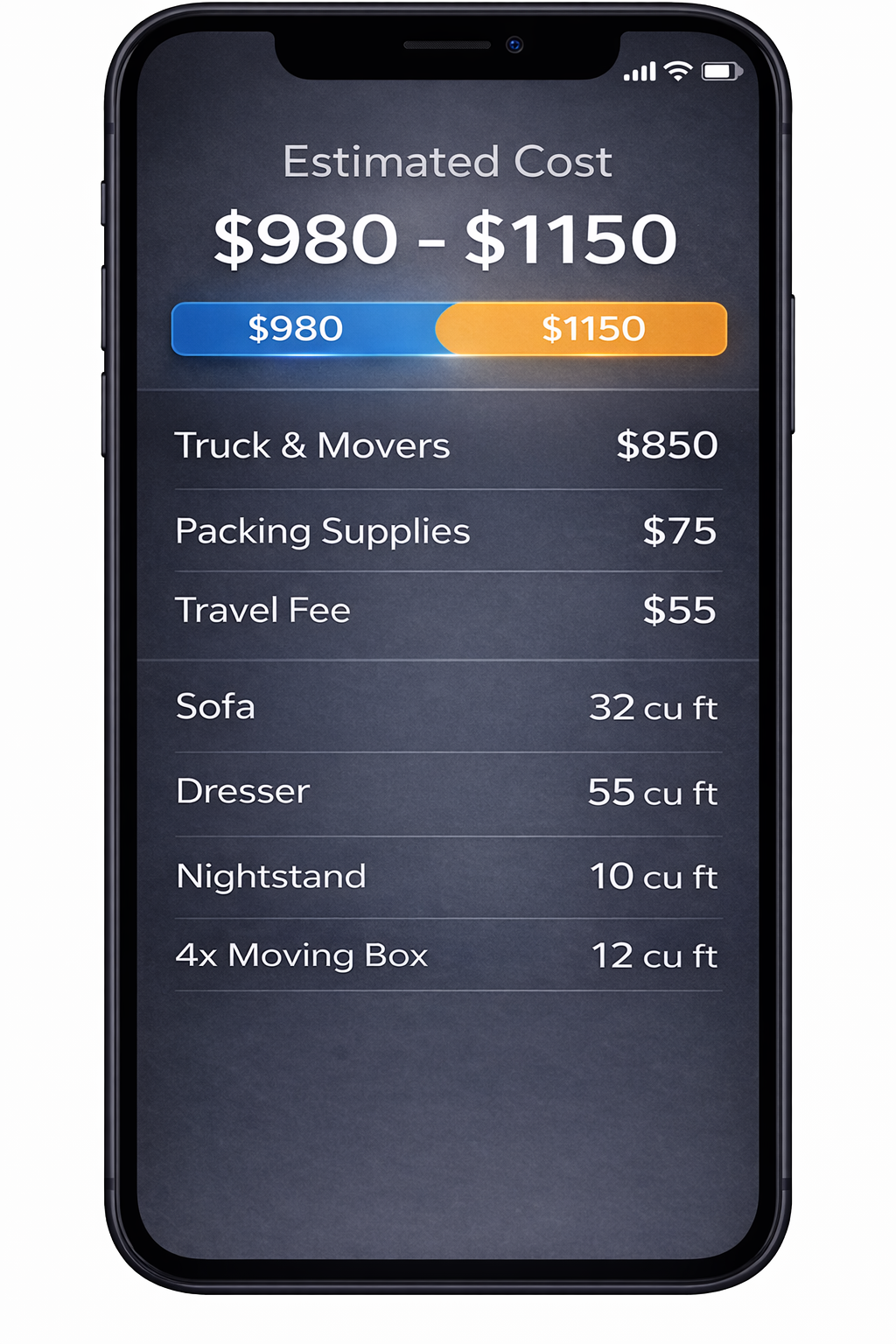
2. AI Detects Your Items
We identify your items and calculate volume for a clearer estimate.
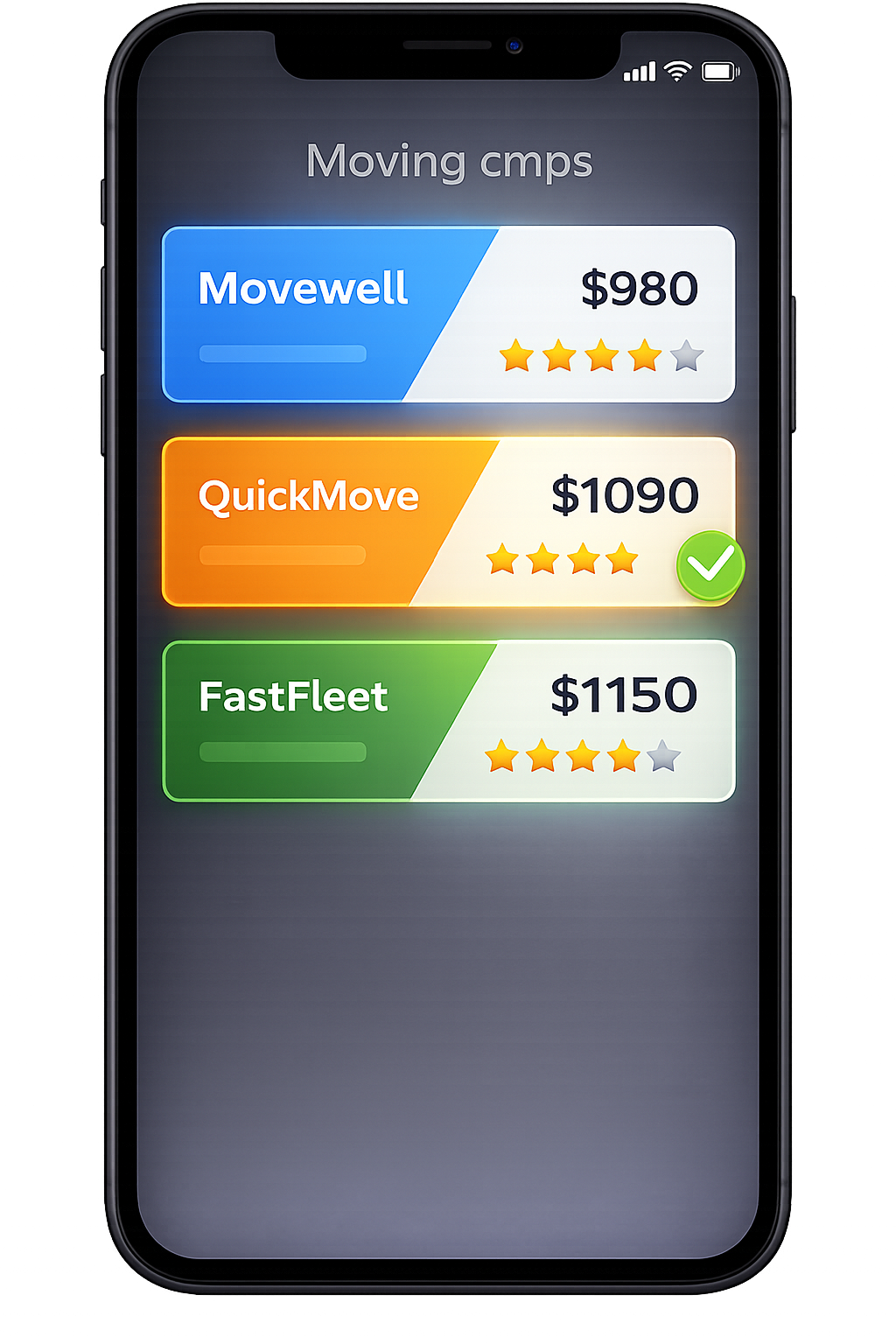
3. Compare Multiple Quotes
Compare mover quotes for Long Distance Movers From Dallas, TX from the same scanned inventory.
Frequently Asked Questions
Is this Dallas page for local moves too, or only for long distance and interstate?
This page is focused on long-distance and interstate moves that start in the Dallas–Fort Worth area, including in-state routes that behave like long distance when you move a full household (Dallas–Austin, Dallas–Houston, Dallas–San Antonio, etc.). If your move stays within the DFW metro, you’ll get a better fit from local-focused tools, such as any dedicated Local Movers in Dallas or the Local Moving Cost Calculator Near Me on MoveCost. You can still use the same AI inventory for both, but this URL is meant to answer questions about Dallas-origin long distance routes, not short across-town jobs.
How do movers decide whether my Dallas route is long distance or just a long local move?
If your move from Dallas crosses a state line—for example, Dallas–Chicago, Dallas–Orlando, or Dallas–Los Angeles—movers treat it as an interstate long distance move, priced around inventory volume/weight, route distance, and timing. When you’re going between Dallas and other Texas cities like Austin, Houston, or San Antonio, many movers still treat full-household moves as long distance or regional because: The crew and truck are tied up for most or all of a day (or more). Fuel and mileage are significant, even within Texas. Planning is closer to a mini long-distance job than a quick local hop. In MoveCost, you simply enter your Dallas origin and destination. Interstate and regional movers quote based on how they classify that route internally; this page keeps the discussion focused on Dallas-origin, long-distance-style moves.
What are the most common long distance routes people book from Dallas?
From Dallas, many long distance movers regularly handle routes like: Within Texas: Dallas–Austin, Dallas–Houston, Dallas–San Antonio, and Dallas–Corpus Christi for full-household, long-distance-style jobs To the Midwest: Dallas–Chicago and other Dallas–Midwest corridor routes To the Southeast & Florida: Dallas–Orlando, Dallas–Tampa, Dallas–Jacksonville, and Dallas–Miami To the West: Dallas–Los Angeles, Dallas–San Diego, Dallas–Bay Area, and other California destinations There are also frequent outbound moves from suburbs like Plano, Frisco, McKinney, Garland, Richardson, Irving, and Grand Prairie to neighboring states such as Oklahoma, Arkansas, Louisiana, Colorado, and Florida. This Dallas long-distance page stays focused on those Dallas-origin routes, while national tools like Moving Cost Calculator by State and City and State to State Moving Cost Calculator Online help you compare them against routes starting in other cities.
How long does a long distance move from Dallas usually take to deliver?
Delivery timing depends on distance, your shipment size, whether your items share a truck, and time of year. Typical patterns movers often quote for Dallas-origin lanes: Dallas–Austin or Dallas–Houston: often 1–3 days from pickup, sometimes same- or next-day for smaller moves. Dallas–Chicago or Dallas–Florida cities: commonly 3–7 or 4–8 business days. Dallas–California and other cross-country routes: often 5–12+ business days, especially in peak season or when your shipment shares a truck. Within MoveCost, each mover shares their own projected window for your specific Dallas route and inventory. You can compare these ranges side by side to see whose timing best fits your move-in plan and building rules at your destination.
How far in advance should I book long distance movers from Dallas for routes like Dallas–Florida or Dallas–California?
For longer routes such as Dallas–Florida or Dallas–California, many people are more comfortable booking 6–8 weeks in advance, particularly: Between late spring and early fall If they need specific pickup or delivery windows If their Dallas building has strict elevator/loading-dock rules This lead time gives you room to: Reserve elevators and loading docks at Dallas and destination buildings Coordinate closing or lease dates at your new place Compare multiple movers in MoveCost instead of taking the first available slot. Shorter lanes like Dallas–Austin or Dallas–Houston can sometimes be booked with less notice, but you’ll usually see more options and clearer timing if you start earlier.
Can I begin a Dallas long distance quote if I don’t know my exact move date yet?
Yes. You can start by selecting a target window (for example, “late August” or “first half of October”) and scanning your Dallas home with AI. In MoveCost, you can mark your dates as flexible and add context such as “lease ending late August, closing date pending.” Movers can then: Provide preliminary long-distance estimates from Dallas for that window Suggest pickup and delivery ranges that fit your flexibility Update timing and pricing once you finalize the precise dates Starting early with a scan and window lets you compare options without rushing—then you can narrow down details once your schedule is firm.
What Dallas building details should I tell long distance movers to avoid surprise charges?
To keep your Dallas long distance estimate aligned with your final bill, share as much as you know about access at both ends: Building type and floor level (high‑rise with a freight elevator, mid-rise with a loading dock, walk‑up, or single-family home) Any elevator reservation or move-only time windows required by your building or HOA Parking and loading details: street parking, garage height limits, driveway, alley access, cul‑de‑sac, or shared parking areas Stairs: interior stairs, exterior staircases, and approximate stair counts Any special building rules – COI requirements, restrictions on weekend moves, or limits on start/end times MoveCost’s Dallas flow includes prompts for these items so that when movers price your interstate route, they’re not assuming a simple driveway and ground-floor access in perfect weather.
How does the Dallas AI inventory scan help if I have extra stops like a storage unit?
If your long distance move from Dallas involves multiple pickup points—for example, your main home plus a storage unit in Garland or a small office in Plano—you can reflect that inside MoveCost. You can: Scan your primary Dallas home first Add items from secondary locations via notes, photos, or an additional mini scan Label them clearly (for example, “storage pickup in Garland,” “office items in Plano”) Long distance movers then: See that there are extra stops to include in their routing Can plan additional time and mileage for those pickups Adjust estimates so they’re closer to what the multi‑stop job will actually require Capturing extra stops early keeps your long distance estimate from being under-scoped and avoids last‑minute add-on charges when crews discover another location on move day.
What’s the difference between this Dallas long-distance page and the general MoveCost calculators?
This Dallas page is the Dallas–origin long distance movers hub. It: Uses examples built around Dallas–Austin, Dallas–Houston, Dallas–Chicago, Dallas–Florida, and Dallas–California routes Explains how Dallas building rules, weather, and highway patterns shape your cost and timing Lives as a city-specific “leaf” under broader interstate tools like the State-to-State and State/City calculators By contrast, general MoveCost calculators like: AI Moving Cost Calculator Online Free State to State Moving Cost Calculator Online Moving Cost Calculator by State and City …are route-agnostic hubs. They’re built to work for any origin/destination pair across the U.S., not just Dallas. In practice: You build your inventory on the AI hub Use the state-to-state and state/city tools to test cost behavior across multiple states and cities Then use this Dallas long distance movers page when you know your origin is Dallas and you want local, route, and timing nuance for leaving the DFW area. That separation helps this URL stand out as the Dallas-specific long distance resource rather than as a copy of national tools.