
Moving Cost in Atlanta, GA: Realistic Local & Long‑Distance Prices
Use this page as your primary 2026 reference for what moves in Atlanta actually cost—from short hops inside the Perimeter to suburb and interstate routes. Then run a free MoveCost AI home scan to see your own Atlanta moving estimate and compare movers online with our AI moving cost calculator.

moving cost in Atlanta, GA
How Moving Costs Work in Atlanta (And Why This Page Exists)
This page is meant to be the primary cost resource for moving in Atlanta—not a generic national average that ignores I‑285 traffic, Buckhead elevators, or Decatur walk‑ups. Most local moves within the Atlanta metro (often within 30–40 miles of Downtown and commonly inside or just outside the Perimeter) are billed hourly. Long‑distance moves into or out of Georgia are usually priced around shipment size and miles traveled. Instead of guessing from a basic calculator, MoveCost uses AI-based home scanning to build a detailed inventory of what you’re moving. That inventory is then shared with multiple Atlanta movers so you can compare estimates side by side. Use this page to: • See realistic example cost ranges for common Atlanta move types. • Understand how stairs, elevators, parking, and traffic on the Connector or I‑285 can change your price. • Learn the difference between a rough Atlanta moving estimate and a finalized quote. • Decide when to schedule your move to avoid the most expensive time slots. • Know when to switch from this guide into an actual AI moving cost calculator online free for precise numbers. All ranges on this page are directional examples based on typical Atlanta scenarios. They’re not offers or guarantees, but they give you a grounded starting point before you scan your own home with MoveCost. If you’re ready to move from ranges to a tailored figure, you can open the central AI Moving Cost Calculator Online Free and select your Atlanta route: • Use the main hub here: https://movecost.ai/ai-moving-cost-calculator-online-free • Or, if you know it’s a short in‑metro move, pair this guide with the Local Moving Cost Calculator Near Me: https://movecost.ai/local-moving-cost-calculator-near-me
Local Atlanta Moving Cost Ranges: Inside I‑285 and Nearby Suburbs
Every move is different, but you can still benchmark your budget by looking at common Atlanta scenarios. These examples are not quotes or offers; your actual cost will depend on your exact inventory, access, date, and mover. They’re here to give you context before you run your own AI scan. If you already know your addresses, you can plug them into MoveCost’s Local Moving Cost Calculator Near Me after reading this section: https://movecost.ai/local-moving-cost-calculator-near-me 1. Small apartment move inside the Perimeter (intown I‑285) Typical scenario: One‑bedroom or compact two‑bedroom apartment, moderate furniture, some boxes. Example routes: • Midtown to Inman Park • West Midtown to Decatur • Old Fourth Ward to Virginia‑Highland For short, intown routes with normal access, many people see totals that commonly land somewhere in the low‑to‑mid hundreds of dollars with a 2–3 mover crew and a standard hourly minimum. Extra stair flights, tight hallways, or tricky parking (for example, on a busy side street with no driveway) can push you above that range because the crew needs more time. 2. Larger apartment or townhome inside I‑285 Typical scenario: Larger two‑bedroom or three‑bedroom apartment or townhome with heavier furniture and more boxes. Example routes: • Buckhead high‑rise to a townhome in Brookhaven • Edgewood apartment to a larger place in Grant Park • Sandy Springs complex to another community along GA‑400 With more rooms, heavier pieces, and elevators or longer walks from parking garages, many of these moves fall in the mid‑to‑upper hundreds of dollars for local jobs. Tight elevator windows, loading dock rules, or high‑rise logistics can extend crew time and increase the total. 3. Single‑family home move across the Atlanta metro Typical scenario: Three‑ or four‑bedroom house with garage and outdoor items. Example routes: • Roswell to Decatur • Johns Creek to Peachtree City • Mableton to Dunwoody • Kennesaw to Stockbridge For larger homes with garage storage, attic items, and outdoor furniture, totals frequently land well into the hundreds and often into the low thousands of dollars or more. Adding packing help, extra movers, or complex driveways (such as steep or narrow access common in some hilly areas) can raise the final number. After you’ve looked at these ranges, you can open the AI Moving Cost Calculator Online Free (https://movecost.ai/ai-moving-cost-calculator-online-free), enter your Atlanta addresses, and let the AI turn your actual rooms into a tailored estimate instead of relying on these broad examples.
What Drives Your Moving Cost Up or Down in Atlanta
Distance matters, but around Atlanta, access and traffic often change the bill just as much. Distance and traffic patterns A short hop from Decatur to Inman Park is a very different job from crossing the metro in rush hour from Kennesaw to Stockbridge. Local movers typically bill from the time they leave their base until they return. Extra time spent on the Downtown Connector, I‑285, I‑85, GA‑400, or Peachtree Street can increase your final bill even if the mileage looks small. Inventory volume (how much you own) The more furniture and boxes you have, the more labor time and truck space the crew needs. For example: • A minimalist one‑bedroom in West Midtown with a small sofa and a few boxes usually takes less time than • A fully furnished two‑bedroom in a high‑rise near Atlantic Station with a sectional, large dining set, multiple TVs, and storage. MoveCost’s AI scan lets you walk around your home and automatically build an inventory list so movers see what you actually have instead of guessing from a quick call. If you want to understand how your Atlanta inventory compares with other cities and states, you can also check the Moving Cost Calculator by State and City here: https://movecost.ai/moving-cost-calculator-by-state-and-city Stairs, elevators, and long carries Access quirks are common across the city: • Older walk‑ups in Virginia‑Highland or Grant Park with narrow staircases. • Midtown and Buckhead high‑rises with freight elevator reservations and strict move windows. • Apartment communities along the BeltLine with long walks from parking garages. Extra stair flights, small elevators, or long carries slow crews down and sometimes require an additional mover, which can increase your cost. If you know your Atlanta move will involve multiple stair flights or elevators, you can also experiment with MoveCost’s Moving Cost Calculator Including Stairs and Elevator: https://movecost.ai/moving-cost-calculator-including-stairs-and-elevator Parking, loading docks, and COI requirements If the truck can back into a driveway in Marietta or Peachtree Corners, loading is usually faster. By contrast, Downtown and Buckhead condos may require loading docks, parking permits, or a certificate of insurance (COI). Some buildings limit move times to specific weekday windows. These constraints can affect how long the job takes and may be reflected in your price. Special items and packing Items such as upright pianos, large sectionals, gym equipment, glass tables, or overfilled garages in the suburbs add time and may require extra materials. If you ask movers to pack your kitchen, closets, or home office, that additional labor will also show up in your estimate. When you request quotes through MoveCost, your AI‑generated inventory and access notes are included so Atlanta movers can factor these details into their pricing upfront, instead of surprising you on move day.
Long‑Distance Moving Costs To or From Atlanta
If you’re moving into the Atlanta area from another state—or leaving Georgia for a new city—pricing usually shifts from hourly to shipment‑based. Long‑distance movers typically look at: • The size of your shipment (by weight or volume). • The miles between your current home and your new one. • Access conditions at both ends (stairs, elevators, parking, driveways). • How flexible you are with pickup and delivery dates. Directional examples: • A relatively small two‑bedroom apartment move from Atlanta to nearby cities like Charlotte or Nashville often falls toward the lower end of long‑distance price ranges because the mileage is modest and the shipment is smaller. • A compact one‑bedroom move from another Southeast city into an Atlanta high‑rise with limited furniture may also land at the lower end, especially if you’re flexible on dates. More complex and more expensive scenarios include: • A full four‑bedroom house moving from metro Atlanta to cities like New York or Chicago, across multiple states and hundreds of miles. • A large family home moving from out of state into an Atlanta suburb with a packed garage, attic storage, and outdoor items. These jobs are difficult to estimate by feel alone. A detailed inventory is critical, which is where MoveCost’s AI-based home scanning helps. You can walk through each room—bedrooms, basement, garage, patio—and the tool creates an organized list that long‑distance movers use to provide more precise estimates. If you know your origin and destination, you can pair this guide with MoveCost’s State to State Moving Cost Calculator Online to model your route: https://movecost.ai/state-to-state-moving-cost-calculator-online For broader context beyond a single route, you can also explore the Moving Cost Calculator by State and City to see how Atlanta compares to other metros by distance band and typical move size.
Atlanta Moving Costs by Season, Day, and Time
Atlanta has clear busy and slower periods, and that demand pattern often shows up directly in prices and availability. Peak season (roughly May through August) Demand is usually highest when school is out and leases turn over: • Families in Gwinnett, Cobb, DeKalb, and Fulton counties often try to move between school years. • Many leases renew in summer around Midtown, Old Fourth Ward, Sandy Springs, and other intown neighborhoods. During these months, weekend and end‑of‑month dates tend to book quickly and may be priced at the higher end of a mover’s range or come with less flexibility. Off‑peak months (roughly November through February) Atlanta doesn’t see harsh winters most years, but it does have a slower moving season. If your schedule is flexible, mid‑week and mid‑month dates in fall or winter are often easier to book and can sometimes be more budget‑friendly. Time of day and traffic Starting a move at 8:30 a.m. and getting stuck on the Connector or I‑285 can add meaningful time to your bill. Many movers let you request earlier starts or plan around building rules: • Some Downtown and Buckhead buildings only allow weekday moves. • Certain condos require specific elevator windows or loading dock reservations. When you use MoveCost to compare quotes, you can test different dates and times to see how your Atlanta moving estimate changes, then choose the schedule that fits both your budget and your building’s rules. If you want to see how Atlanta’s patterns line up with other U.S. cities, you can also open the Moving Cost Calculator by State and City and compare ranges across metros: https://movecost.ai/moving-cost-calculator-by-state-and-city
Using AI to Get an Accurate Atlanta Moving Cost
Atlanta moves are easy to underestimate—especially in dense neighborhoods or multi‑level homes. A quick description like “two‑bedroom in Grant Park” could mean anything from a lightly furnished space to a fully loaded home with attic storage, patio furniture, and a packed garage. MoveCost is built to reduce the guesswork. Step 1: Scan your Atlanta home with AI Use your phone to walk through rooms such as: • Living rooms and bedrooms (beds, dressers, TVs, sectionals). • Kitchen and dining spaces (tables, chairs, barstools). • Home offices, garages, storage units, or sheds (desks, shelves, bins). • Balconies or patios in intown apartments and townhomes. The AI turns your walkthrough into an organized inventory list. Step 2: Enter your Atlanta route Submit your current and new addresses, whether you’re: • Moving from a Midtown apartment to a townhome in Brookhaven, • Relocating from a house in Johns Creek to another suburb, or • Leaving Atlanta for another state. Step 3: Compare mover estimates side by side Your inventory goes to movers who regularly handle Atlanta routes. They see the same list of items and access notes, so they can build detailed estimates instead of rough guesses. Inside your MoveCost dashboard, you can: • Compare hourly rates and minimums for local Atlanta moves. • See how each mover handles stairs, elevators, long carries, or parking constraints. • Adjust your inventory—such as removing a couch you decide to sell—and request updated numbers. To launch the central AI experience from this Atlanta page, use the AI Moving Cost Calculator Online Free – Primary Scan-Based Tool: https://movecost.ai/ai-moving-cost-calculator-online-free By starting with a realistic inventory, you anchor your Atlanta moving cost to the actual items you plan to move instead of relying solely on bedroom counts or generic calculators.
How This Atlanta Guide Fits with MoveCost Calculators
It’s easy for Google—and for people—to mix up a city cost page with a generic moving cost calculator. This section explains how they work together so you know when to stay on this page and when to jump to a tool. This Atlanta page is an educational cost guide. It exists to: • Explain typical moving costs in Atlanta with concrete, neighborhood‑level examples. • Show how local factors—like traffic on the Connector, Buckhead high‑rises, or Decatur walk‑ups—change your bill. • Give you language and context to understand quotes you receive. It does not try to replace a calculator or guarantee a price for your specific home. MoveCost’s calculators are interactive tools. Once you’re done learning here, you can: • Use the AI Moving Cost Calculator Online Free as your primary scan‑based tool: https://movecost.ai/ai-moving-cost-calculator-online-free • Use the Local Moving Cost Calculator Near Me when your move stays within the Atlanta metro: https://movecost.ai/local-moving-cost-calculator-near-me • Use the Moving Cost Calculator by State and City if you’re comparing Atlanta to other cities or planning a state‑to‑state route: https://movecost.ai/moving-cost-calculator-by-state-and-city Think of this page as the Atlanta chapter in your research and the calculators as your inputs and outputs engine. You can read here, then send your scan and addresses through the calculators to get estimates that reflect your exact Atlanta route and home layout.
Moving Estimate Atlanta: Turning Ranges Into a Route‑Specific Number
People often search for “moving estimate Atlanta” when they’re ready to move beyond vague averages and see a number that reflects their actual route and home. The example ranges on this page tell you how different Atlanta scenarios typically land—small intown apartments versus larger suburban homes—but an Atlanta moving estimate becomes more useful when it: • Uses a detailed inventory list instead of just bedroom count. • Includes your real origin and destination (for example, Midtown to Inman Park vs. Kennesaw to Stockbridge). • Accounts for stairs, elevators, parking rules, and building policies at both addresses. • Reflects your preferred move date, time window, and any packing help. MoveCost connects these pieces by combining an AI-based home scan with structured questions about your Atlanta addresses and access. That information is shared with movers so they can base their estimates on your specific situation rather than generic inputs. If you want your own moving estimate for Atlanta, you can: 1. Start a free scan from this page via the AI Moving Cost Calculator Online Free: https://movecost.ai/ai-moving-cost-calculator-online-free 2. Confirm your Atlanta‑area route and any long‑distance details inside the estimator. 3. Review estimates from movers who serve that route, then refine your plan as you add or remove items. For broader context beyond Atlanta, you can also explore MoveCost’s Moving Cost Calculator by State and City, which lets you see how Atlanta compares to other metros: https://movecost.ai/moving-cost-calculator-by-state-and-city
Moving Quotes Atlanta: Comparing Multiple Companies With One Scan
If you’re searching for “moving quotes Atlanta”, you probably want to see prices from more than one moving company—without repeating your inventory on multiple phone calls or web forms. With MoveCost, your AI-generated inventory becomes the shared foundation for multiple quotes from movers that regularly handle Atlanta and the surrounding metro. Instead of: • Filling out separate forms for each mover, or • Scheduling multiple in‑home walk‑throughs for the same apartment or house, you can: • Complete one AI-powered scan of your home. • Add key Atlanta‑specific details like stairs, elevator access, and parking notes. • Receive several quotes built from the same information. This makes it easier to see how each company prices: • Base hourly rate or shipment cost. • Minimum hours for local Atlanta jobs. • Travel fees to and from your neighborhood. • Packing options, materials, and any potential extra charges. From there, you can ask follow‑up questions, adjust your inventory if your plans change, and choose the mover whose quote, availability, and service level are the best fit for your Atlanta move. If you want to focus specifically on fast, online quotes, you can pair this page with MoveCost’s dedicated guide to instant moving quotes without phone calls (https://movecost.ai/instant-moving-quotes-without-phone-calls) and its comparison tool for comparing moving company quotes instantly online (https://movecost.ai/compare-moving-company-quotes-instantly-online). For purely local, short‑distance movers, you can also look at the Compare Local Movers Prices in My Area Online page: https://movecost.ai/compare-local-movers-prices-in-my-area-online
How It Works

1. Scan Your Room With Your Phone
Walk around your space and scan your items in seconds.
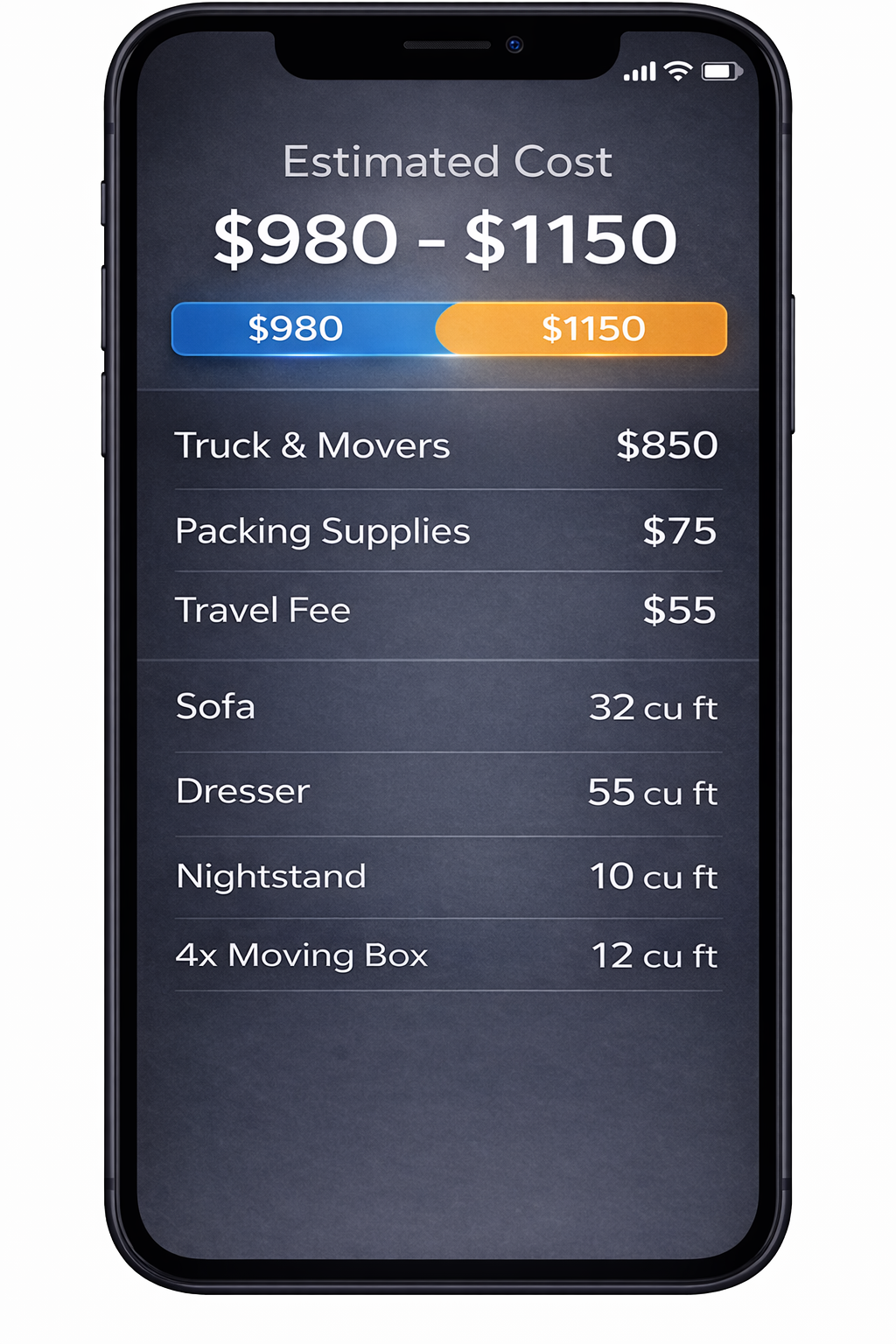
2. AI Detects Your Items
We identify your items and calculate volume for a clearer estimate.
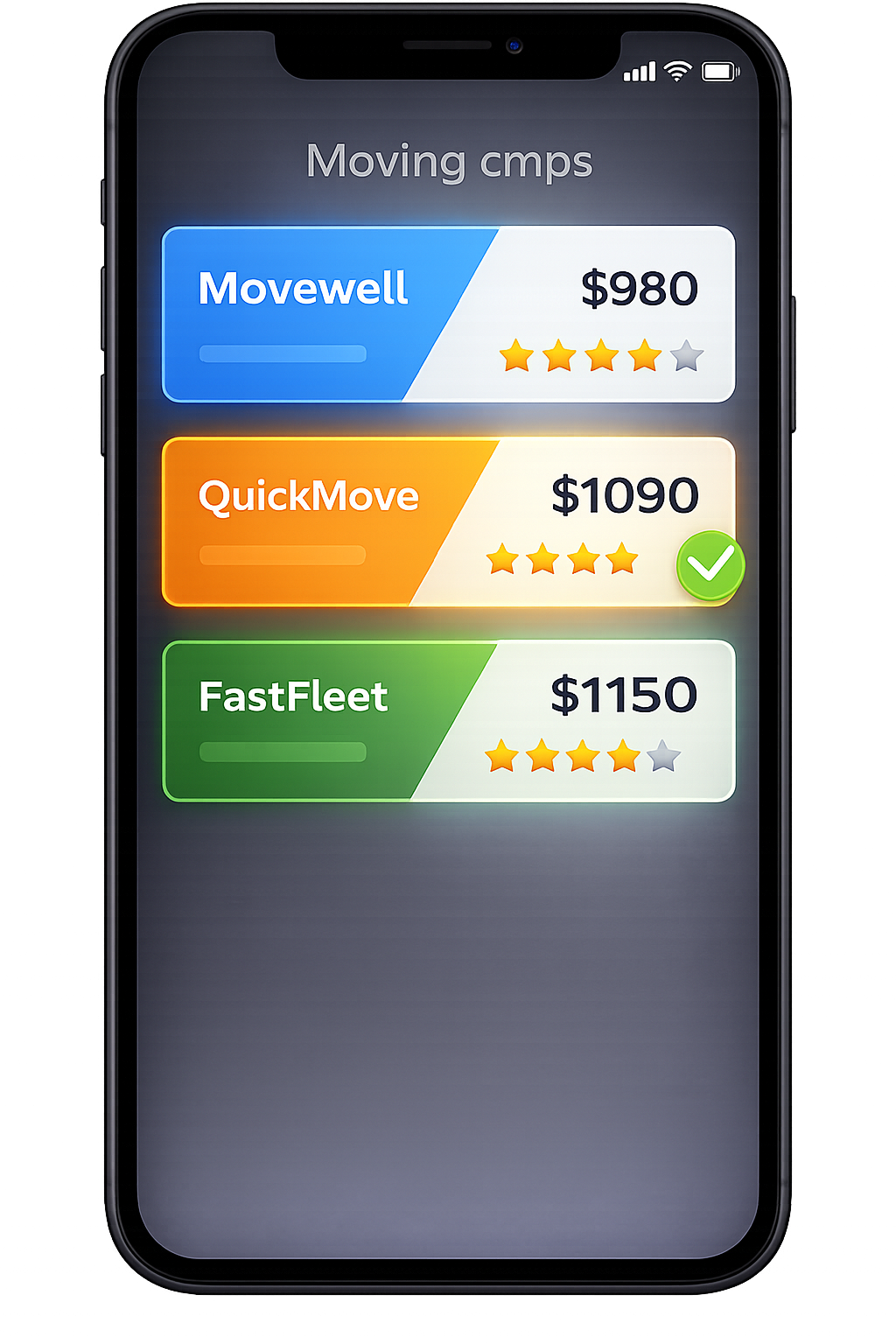
3. Compare Multiple Quotes
Compare mover quotes for Atlanta, GA from the same scanned inventory.
Frequently Asked Questions
How much does it usually cost to move a one‑bedroom apartment within Atlanta?
For a typical one‑bedroom move within the metro area—such as from Midtown to Inman Park or from West Midtown to Decatur—many people see totals that land somewhere in the low‑to‑mid hundreds of dollars when hiring a local moving crew. Your cost depends on how much furniture and how many boxes you have, how easy it is to reach your unit (ground‑floor vs. multiple stair flights or a small elevator), and how far your truck has to travel in traffic. These figures are directional ranges rather than offers or guarantees. If you want to translate this into a personalized figure, you can: Scan your apartment with MoveCost using the AI Moving Cost Calculator Online Free: https://movecost.ai/ai-moving-cost-calculator-online-free Or, if you’re sure your move is local, use the Local Moving Cost Calculator Near Me for Atlanta‑style moves: https://movecost.ai/local-moving-cost-calculator-near-me Using those tools gives movers a clearer picture of your items and access, which can help produce tighter estimates for your specific Atlanta route.
Do stairs, elevators, or Buckhead/Midtown parking really change my moving cost?
They can. In denser parts of Atlanta—Buckhead, Midtown, Downtown, and older walk‑up buildings in neighborhoods like Virginia‑Highland or Grant Park—crews often deal with narrow staircases, small elevators, loading docks, and street parking. Each of these factors can slow the move, and local movers typically charge by the hour, so additional time raises the final cost. When you request quotes through MoveCost, you can include details about stairs, elevator access, loading zones, and parking. Movers can then account for those conditions in their estimates instead of adjusting the price after they arrive. If your home has a lot of stairs or tricky elevator access, it’s worth experimenting with the Moving Cost Calculator Including Stairs and Elevator to see how access can shift your estimate: https://movecost.ai/moving-cost-calculator-including-stairs-and-elevator
Is it cheaper to move on a weekday instead of a weekend in Atlanta?
Many Atlanta movers are busiest on Fridays, Saturdays, and at the beginning or end of each month—especially in summer when leases change and families coordinate around school calendars. Because of that demand, weekday and mid‑month moves often have better availability and may be priced more competitively. Some buildings in areas like Downtown and Buckhead also prefer weekday moves for elevator and lobby management, which limits your options on weekends. If your schedule is flexible, it’s worth using MoveCost to get estimates for at least one weekday and one weekend date to see how the price and availability compare for your move. You can quickly test multiple dates using the AI Moving Cost Calculator Online Free hub: https://movecost.ai/ai-moving-cost-calculator-online-free
How can I avoid surprise moving charges when moving across the Atlanta metro?
Surprise charges usually show up when the mover discovers more items or tougher access than expected. To reduce this risk: Make your inventory as complete as possible, including garage, attic, storage units, balconies, and outdoor furniture. Be clear about access challenges like steep driveways, narrow streets, long walks from parking, or freight elevator rules. Ask movers how they handle potential extra time due to traffic or building policies. MoveCost’s AI scan helps you capture items room by room, and the quote process prompts you for Atlanta‑specific details. That way, movers can build estimates that more closely match what they will encounter on move day. If you’re new to this, you can also read the Moving Estimate Guide for First‑Time Movers before you compare Atlanta quotes: https://movecost.ai/moving-estimate-guide-for-first-time-movers
I’m moving from another state into the Atlanta area. How do I estimate that cost?
For out‑of‑state moves into Atlanta, the main cost drivers are distance, shipment size, and access at each home. A practical approach is to: 1. Build a detailed inventory of everything you plan to move using MoveCost’s AI scan in your current home. 2. Provide your origin city and your destination in the Atlanta area—whether that’s a Midtown high‑rise, a house in East Cobb, or a townhome in Sandy Springs. 3. Note any access quirks like stairs, elevators, or parking constraints at both ends. You can then review estimates from long‑distance movers that regularly run those routes. To put your route into context, you can use: The State to State Moving Cost Calculator Online: https://movecost.ai/state-to-state-moving-cost-calculator-online And the Moving Cost Calculator by State and City if you want to compare Atlanta with other destination options: https://movecost.ai/moving-cost-calculator-by-state-and-city The result is a realistic range for your specific move, instead of relying on general national averages.
What’s the difference between an Atlanta moving estimate and an actual quote?
An estimate is a mover’s best projection of what your Atlanta move will cost based on the information you provide—such as bedroom count, a rough inventory, and addresses. A quote is usually more detailed and may spell out how pricing works if conditions change, like if you add items, if there is unexpected stair or elevator usage, or if the move takes longer than planned. By using MoveCost to provide an AI-generated inventory and clear building details upfront, you give movers the information they need to create more precise estimates and quotes, which narrows the gap between the projected and final price. If you’d like a deeper walkthrough of this difference, you can read the Moving Estimate Guide for First‑Time Movers: https://movecost.ai/moving-estimate-guide-for-first-time-movers
How does MoveCost help with Atlanta moves compared to a basic moving cost calculator?
Basic calculators often ask for only distance and number of bedrooms, which can miss key Atlanta factors like stair‑heavy walk‑ups, long hallway carries in large complexes, or traffic around I‑285 and the Connector. MoveCost starts with an AI scan of your home to capture a detailed item list, then adds structured questions about access and location that are especially relevant in Atlanta. That completed profile is shared with multiple movers, so each one builds its estimate from the same, more accurate data rather than a few generalized inputs. You can then compare estimates and make informed decisions about your Atlanta move. You can launch the AI Moving Cost Calculator Online Free from here: https://movecost.ai/ai-moving-cost-calculator-online-free. For short, in‑metro moves, you can also send your inventory into the Local Moving Cost Calculator Near Me: https://movecost.ai/local-moving-cost-calculator-near-me
Can I use this Atlanta cost page with other MoveCost tools?
Yes. This page is designed as a deep‑dive cost guide specifically for Atlanta. Once you understand the local patterns and examples here, you can: Use the AI Moving Cost Calculator Online Free to generate a more detailed estimate based on your exact route: https://movecost.ai/ai-moving-cost-calculator-online-free Try the Local Moving Cost Calculator Near Me to compare your Atlanta move with similar city‑to‑city jobs: https://movecost.ai/local-moving-cost-calculator-near-me Explore the Moving Cost Calculator by State and City if you want to see how Atlanta compares to other metros: https://movecost.ai/moving-cost-calculator-by-state-and-city Or run a state‑to‑state scenario if you’re leaving Georgia using the State to State Moving Cost Calculator Online: https://movecost.ai/state-to-state-moving-cost-calculator-online All of these tools use the same inventory‑driven approach, so your AI scan can power multiple views of your moving cost without repeating the work.