
Local movers in Houston who actually understand your building, your block, and your schedule
Scan your place with AI, see your moving volume, and compare local Houston movers who already know your neighborhood’s elevators, HOAs, parking rules, and traffic patterns—from Inside the Loop to Katy, Sugar Land, and The Woodlands.

local movers in Houston, TX
A Houston-focused way to plan a local move—without endless phone calls
A short move inside Houston can be more complicated than a long move out of state. The distance is small, but everything else isn’t: Inner Loop traffic, narrow Montrose streets, Downtown loading docks, Katy HOA rules, or third-floor walk-ups off Westheimer. MoveCost is built for that reality. Instead of starting with a rough guess like “one-bedroom apartment,” you start with your actual home: 1. Scan your Houston home with AI – Walk through your apartment, townhome, or house using your phone. Our AI-based home scanning turns what it sees into a moving inventory and volume estimate. 2. Add Houston-specific details – Note things like your floor, elevator or stairs, parking distance, and whether your building is in Downtown, Midtown, the Heights, Montrose, Galleria, Medical Center, Energy Corridor, Katy, Sugar Land, Pearland, Spring, or The Woodlands. 3. Compare local movers side by side – Your inventory and access notes are shared with professional movers who serve your exact route. You see how they consider typical Houston issues like traffic windows, summer heat, storm forecasts, and building rules. You end up with grounded local estimates—based on your real belongings and building conditions—without repeating your move details over and over on the phone. If you want to understand the broader math behind these estimates, you can also review our Moving Estimate Guide for First-Time Movers, then come back to this Houston page to apply those ideas to your specific neighborhood.
Inside the Loop vs. suburbs: local Houston movers plan these differently
Local movers in Houston don’t treat a move from Midtown to Montrose the same as a move from Cypress to Pearland—and your estimates shouldn’t either. MoveCost lets you highlight the quirks of your exact neighborhood so movers can plan more precisely: • Inner Loop (Downtown, Midtown, Montrose, Heights, EaDo) – Expect more one-way streets, tight street parking, shared elevators, loading docks, and time windows set by building management. A move from a high-rise Downtown to a Montrose fourplex can require freight elevator reservations, dock passes, and careful truck placement. • Galleria, Greenway, and Upper Kirby – Many mid-rises and high-rises around the Galleria area have move-in/move-out schedules, limits on weekend moves, and rules for padding elevators and reserving loading zones. • Medical Center and Museum District – Apartment communities here often sit on busy corridors with limited space for large trucks. Movers may need smaller trucks or extra time for shuttling from visitor parking to your building. • Suburban moves (Katy, Cypress, Sugar Land, Pearland, Spring, The Woodlands, League City) – Single-family homes and townhomes in master-planned communities bring different constraints: HOA rules about truck parking, gate codes, cul-de-sacs that limit large trucks, and longer drives along Beltway 8, Highway 6, I-10, 45, 59, or 290. On MoveCost, these details aren’t hidden. You can include notes like “freight elevator in Downtown high-rise, must reserve,” “townhome in Katy with narrow driveway,” or “Heights bungalow with alley access only.” Local movers use these notes to recommend crew size, truck type, and realistic time windows, which helps keep your hourly estimate grounded in Houston’s actual conditions.
What really drives local moving costs in Houston
Most local movers in Houston charge by the hour, but the number of hours is heavily influenced by Houston-specific factors that generic calculators tend to ignore. On MoveCost, your AI inventory and building notes are paired with key local cost drivers: • Traffic and route choice – A Sunday morning move from the Heights to EaDo is not the same as a weekday rush-hour move from Katy to the Galleria. Movers look at your timing and typical congestion on I-10, 59, 45, 610, Beltway 8, and the Westpark Tollway when they estimate drive time. • Parking distance and access – A ground-floor unit with a driveway in Spring is faster to load than a third-floor walk-up off Westheimer where the truck can’t get close to the stairwell. Longer walks from truck to door add minutes to every trip. • Stairs, elevators, and loading docks – Downtown high-rises with shared elevators, Midtown mid-rises with reserved freight elevators, and Medical Center buildings with specific move windows all affect how long a crew will be on-site. • Weather and heat – Houston’s summer heat and sudden thunderstorms can slow outdoor carries and require more padding and floor protection, especially when moving between the truck and your building. Instead of promising one universal “average” price for local movers, MoveCost shows you how these factors interact with your actual inventory. A smaller inventory but tricky parking in Montrose can sometimes take as long as a larger inventory with driveway access in the suburbs. If you want to compare your Houston route to typical pricing patterns in other cities, you can open our Local Moving Cost Calculator Near Me — Accurate in Minutes, Not Days in another tab, then come back and run your AI scan with Houston-specific details.
Use AI-based home scanning to get a clearer Houston moving estimate
Local estimates are hard to trust when you start from a guess. Our AI-based home scanning is designed to remove as much guesswork as possible for Houston moves. Here’s how it fits into a typical local move in the area: 1. Walk through your home with your phone – Whether you’re in a Downtown high-rise, a Montrose duplex, a Heights bungalow, or a house in Sugar Land, you record a simple walkthrough. 2. AI turns video into an inventory and volume estimate – Major items like sofas, beds, tables, dressers, desks, TVs, and bookcases are recognized, and you can refine the list and add notes (for example, “king bed needs disassembly” or “upright piano in living room”). 3. Movers see more than just ‘2-bedroom’ or ‘3-bedroom’ – A 2-bedroom apartment in Midtown packed with heavy furniture is very different from a light-furnished 2-bedroom in Katy. Your AI-generated inventory helps movers understand the difference before they quote. 4. You keep your inventory for future moves – If you later relocate from Inside the Loop to the suburbs, or out of Houston entirely, you can reuse and update the same inventory rather than starting from nothing. The same underlying approach powers our broader tools, like the AI Moving Cost Calculator Online Free in Minutes, but here it’s tuned for the specific quirks of local moves in the Houston area.
Plan for Houston’s parking rules, HOAs, storms, and long driveways—before movers arrive
The hardest part of a Houston local move usually isn’t mileage. It’s what happens between the truck and your front door. When you request quotes through MoveCost, you can add practical details about: • Street and garage parking – In Montrose, Midtown, and some parts of the Heights, trucks may need to park on narrow streets with cars on both sides. Downtown high-rises and Galleria-area buildings often ask residents to confirm garage clearance or loading dock access. • HOA and neighborhood rules – Many communities in Katy, Cypress, Sugar Land, The Woodlands, and other master-planned suburbs have HOA rules around where trucks can park, hours when loading is allowed, and how long a truck can stay in front of a home. • Long driveways and cul-de-sacs – A long driveway in a suburban neighborhood or a tight cul-de-sac off a main road may limit truck size and require additional walking distance, both of which affect time estimates. • Storms and heat – Houston thunderstorms, tropical systems, and heat advisories can influence start times and pacing. Movers may suggest earlier starts in July and August or build in more buffer on days with strong storm forecasts. By documenting these conditions upfront and attaching photos where helpful, you give movers a clearer view of your situation. That can make estimates more realistic and help reduce last-minute surprises.
Common local Houston move scenarios—and how to model them in MoveCost
Houston has a few repeatable local move patterns. Modeling yours accurately inside MoveCost helps local movers quote more confidently. 1. Inner Loop apartment to Inner Loop apartment (e.g., Midtown to Montrose) • Likely constraints: freight elevator reservations, shared loading dock, limited street parking, one-way streets. • In MoveCost, focus on: floor number for both buildings, elevator vs stairs, expected walking distance from truck to door, any time windows set by building management. 2. Inner Loop condo to suburban house (e.g., Heights to Katy or Cypress) • Likely constraints: tight urban parking at origin, longer drive time on I-10, 290, or Beltway 8, driveway access at destination. • In MoveCost, focus on: detailed access notes for the condo building and the time of day you expect to cross major freeways. 3. Suburb to suburb within the metro (e.g., Pearland to Sugar Land, Spring to The Woodlands) • Likely constraints: HOA rules, gate codes, cul-de-sacs, long driveways, wider streets for trucks. • In MoveCost, focus on: gate or access instructions, HOA move hours, driveway length, and whether the truck can back up close to the garage. 4. Student or medical relocation near the Texas Medical Center • Likely constraints: busy streets, limited truck parking, visitor garages, strict loading time windows. • In MoveCost, focus on: whether movers will need to use a parking garage, how far it is from garage to unit, and any building-specific rules you’ve received in writing. Using the same AI inventory system, you can test different scenarios—like moving on a weekday vs a weekend—by updating your preferred time and access notes. This gives Houston movers a clearer picture of what they’re saying yes to when they send an estimate.
Compare local Houston movers without repeating your story on the phone
Calling every local mover in Houston to explain your building, your elevator reservation, and your parking situation is slow and frustrating. MoveCost centralizes that effort. Once your AI scan and building details are in place, we share that same information with multiple local Houston movers who serve your route—for example: • Midtown to Montrose • Downtown to the Heights • Galleria to Energy Corridor • Medical Center to Pearland • Katy or Cypress to Inside the Loop You can then: • See hourly rates and estimated hours side by side. • Compare how movers handle drive time, stairs, elevators, and long carries from the truck. • Filter based on availability on your preferred day and experience with your type of building (high-rise, mid-rise, garden-style complex, townhouse, or single-family home). • Ask clarifying questions directly in the platform before you decide who to book. If you like reviewing multiple options at once, you can also look at our broader comparison pages such as Compare Local Movers Prices in My Area Online in Minutes or Compare Moving Company Quotes Instantly Online—With One Simple Scan. Those guides explain how comparing estimates works in general, while this Houston page focuses on the specifics of moves within the metro area.
Save your Houston move details for next time—local or long-distance
Many people in Houston move more than once—switching from a Midtown apartment to a Heights bungalow, then later to a house in Katy, Cypress, or Sugar Land, or even out of state. With MoveCost, your effort doesn’t disappear after one move: • Your AI-generated inventory stays in your account, so you can update it instead of recreating it from scratch. • You can keep notes about what worked during your last move—such as freight elevator timing in a Downtown tower or how a truck fit into your Montrose alley. • If you eventually plan a longer route, such as Houston to another Texas city or a cross-country move, you can use the same inventory as a starting point with tools like the Moving Cost Calculator by State and City or the State to State Moving Cost Calculator Online. The time you invest in getting a precise local estimate now also makes your next move—whether it stays in the Houston metro or not—easier to plan and compare.
How It Works
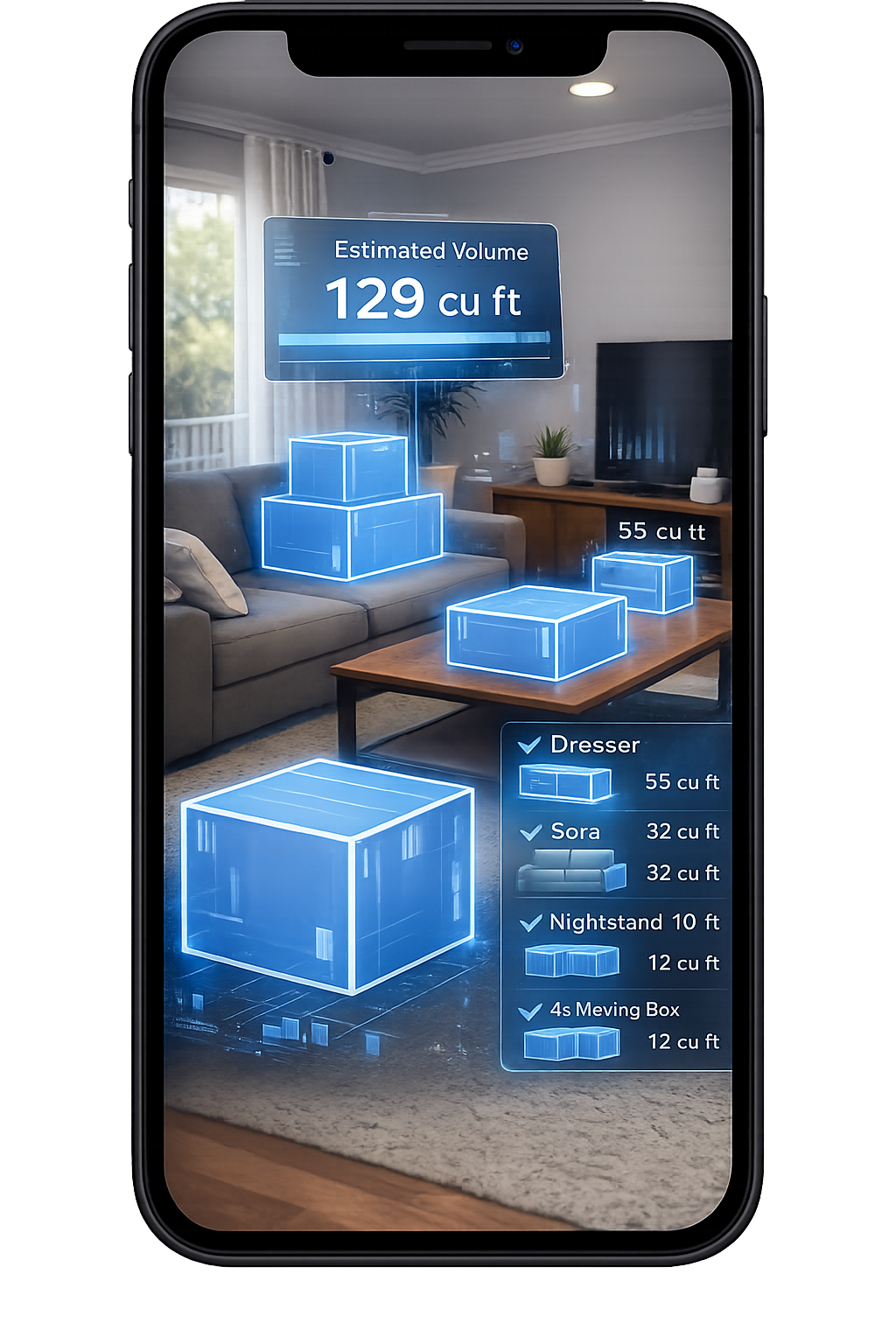
1. Scan Your Room With Your Phone
Walk around your space and scan your items in seconds.
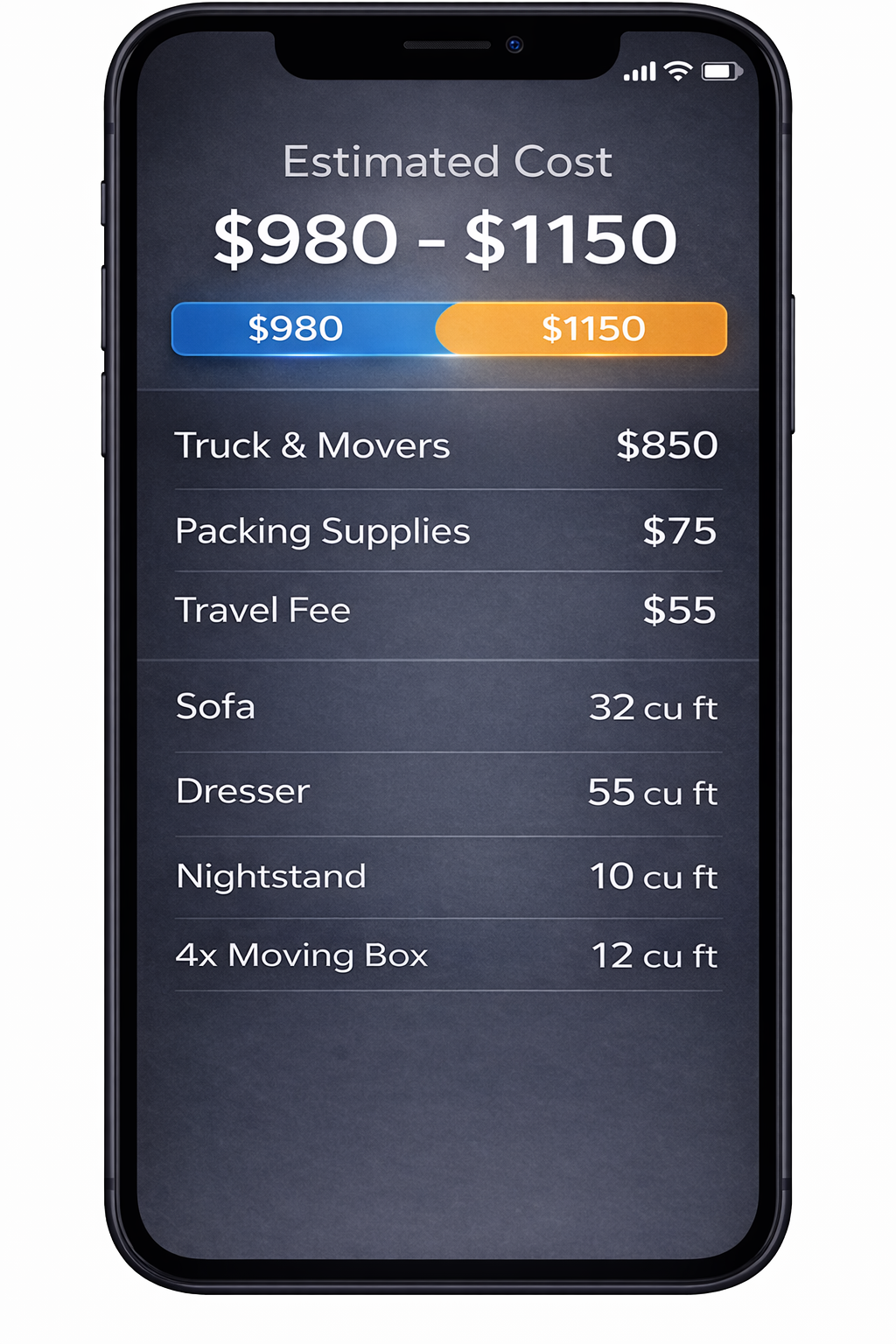
2. AI Detects Your Items
We identify your items and calculate volume for a clearer estimate.
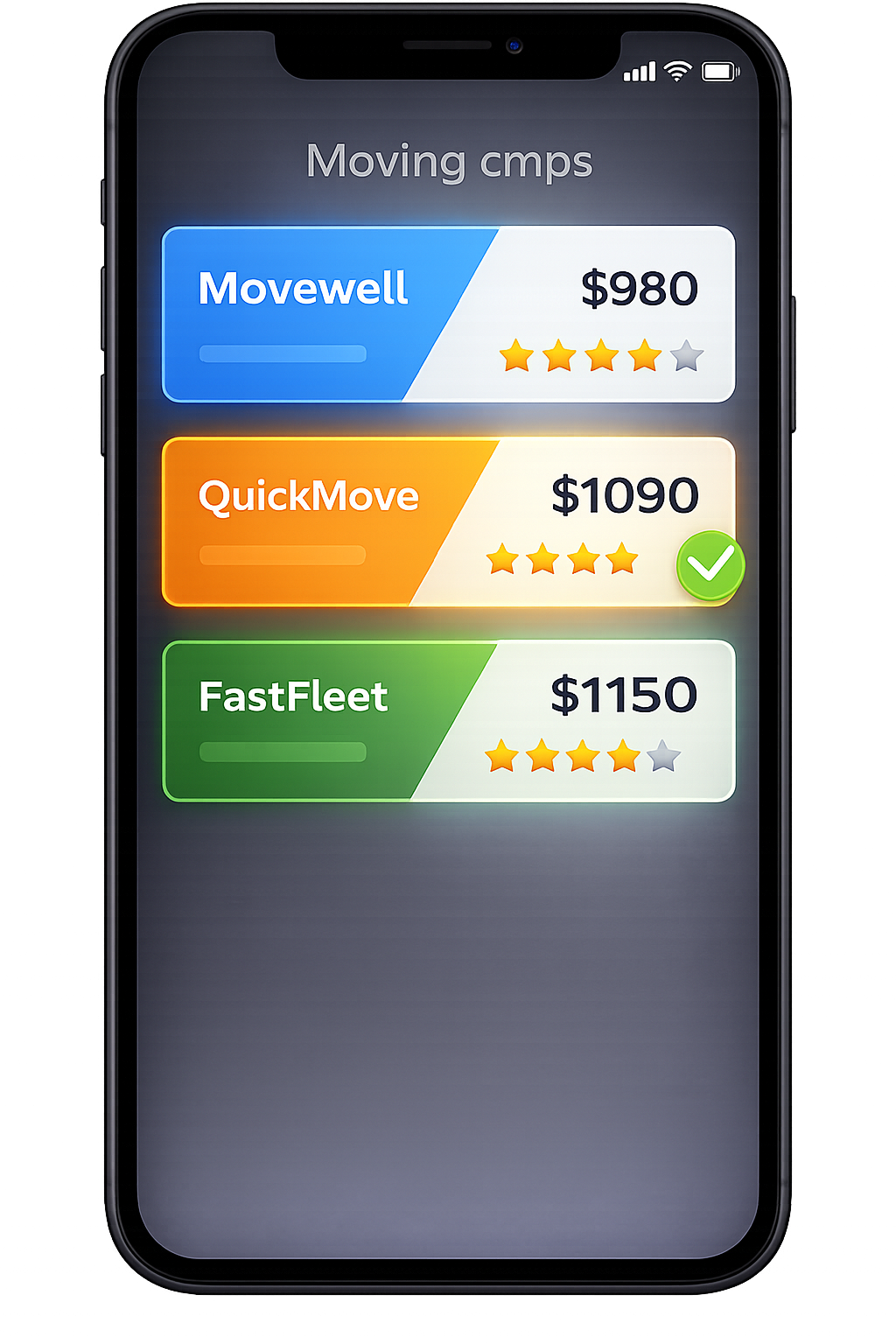
3. Compare Multiple Quotes
Compare mover quotes for Houston, TX from the same scanned inventory.
Frequently Asked Questions
How far in advance should I book local movers in Houston?
For most local apartment and small home moves in Houston, booking 2–3 weeks in advance is a practical target. End-of-month weekends, especially around popular move dates, fill up fastest, and many Inner Loop buildings ask residents to schedule elevator or loading dock time in advance. If you’re moving from or into a high-rise Downtown, a mid-rise in Midtown, Galleria, or the Medical Center, or any community with detailed move rules, check with your leasing office or HOA first to see what time windows are available. Then, use MoveCost to find movers who are free during those slots. If your dates are flexible or you’re moving on a weekday, some movers may have availability with less notice—your MoveCost dashboard will show who is still open on the days you select.
Can Houston movers handle tight parking, garages, or long walks from the truck?
Local movers in Houston regularly deal with: Street parking in dense areas like Montrose, Midtown, and the Heights Garage clearances in Downtown and Galleria-area high-rises Long walks from surface lots to units in large Westheimer or Westchase complexes Driveways and cul-de-sacs in suburbs like Katy, Cypress, Sugar Land, and The Woodlands When you request quotes through MoveCost, you can describe your parking situation and add photos if needed. Movers then decide which truck size to send, where they’re likely to park, whether they might need dollies for longer walks, and how much time to budget for getting items between your home and the truck. Including these details up front helps your local estimate align more closely with what actually happens on move day.
How does the AI scan help with my Houston local moving estimate?
The AI scan gives local Houston movers a clearer picture of what they’re moving than a simple headcount of bedrooms. You walk through your home with your phone, and the scan helps identify items like couches, beds, tables, dressers, desks, bookshelves, and TVs. Combined with your details about floor level, access (stairs or elevator), and parking, this inventory helps movers estimate labor time for your specific route—whether you’re moving a one-bedroom Inside the Loop or a larger home in the suburbs. That time estimate is usually what drives your hourly-based quote, so starting from a real inventory instead of a guess tends to produce more grounded estimates.
What happens if Houston traffic or weather slows down my move?
Local moves in Houston are commonly billed hourly, so conditions like heavy traffic, construction, or severe storms can influence total time. Movers who work in the metro area every day are accustomed to planning around rush hours on I-10, 45, 59, 610, and Beltway 8, and many will recommend start times that avoid the busiest corridors between your addresses. On weather, crews typically keep working through light or moderate rain using floor protection and padding. In cases of dangerous lightning, flooding, or severe storms, they may pause or adjust the plan for safety. When you compare options on MoveCost, you can ask individual movers how they handle drive time, delays, and weather-related interruptions so you understand their approach before booking.
Do local movers in Houston charge extra for stairs, elevators, or long carries?
Policies vary by company, but in Houston the following patterns are common: Some movers include typical stair or elevator use in their hourly rate. Others may add fees for multiple flights of stairs, especially in older walk-up buildings. Long walks between the truck and your unit (for example, across a large parking lot or down a long breezeway) can add to the expected job time. Through MoveCost, you’ll be asked about your floor level, whether you have an elevator, and how far the truck is likely to be from your unit or front door. Movers see these details before providing an estimate. Any additional charges or time adjustments related to access should be reflected in the quote they send through the platform rather than being added at the last minute on move day.
Can I use MoveCost if I’m moving between a Houston suburb and Inside the Loop?
Yes. MoveCost is built for local routes that start or end anywhere in the broader Houston metro—whether you’re moving from a house in Katy or Cypress into a Midtown or Heights apartment, going from an Inner Loop condo to a home in Sugar Land or Pearland, or relocating between two suburban neighborhoods. Your AI inventory stays the same; you simply update your origin and destination addresses and note any new building or parking details so movers can quote accurately for the new route.
What’s the difference between using this Houston page and the general Local Moving Cost Calculator Near Me?
The Local Moving Cost Calculator Near Me looks at typical local pricing patterns across many markets, while this Houston page is written specifically for Inner Loop and suburban routes. If you already know you’re moving within the Houston area, starting here lets you describe local realities like I-10 traffic, Beltway 8 driving time, HOA rules in Katy or Sugar Land, and garage access Downtown. You can still open the general calculator to see how your situation compares to other cities, but your most accurate estimates will come from combining an AI inventory with the Houston-specific access notes on this page.