
Long distance movers in Chicago you can actually compare in one place
Scan your Chicago home with AI, see realistic interstate price ranges, and compare long distance movers for routes like Chicago–New York, Chicago–Dallas, Chicago–Denver and more—before you commit.

long distance movers in Chicago, IL
This Page Is for Long Distance Moves Out of Chicago—not Generic Quotes
MoveCost has (or may have) multiple Chicago-focused pages, each with a specific job: • A general Chicago quotes page (for example, “Moving Quotes in Chicago”) is where you learn how to collect quotes for any Chicago move, local or long distance. • A local-move calculator or comparison page would focus on hourly, same‑metro moves—for example, moving from Lincoln Park to Hyde Park or from Wicker Park to the West Loop. • National calculators like the AI Moving Cost Calculator Online Free, Moving Cost Calculator by State and City, and State to State Moving Cost Calculator Online explain how your inventory behaves for any origin/destination pair across the U.S. This page is different: it’s the long distance / interstate hub specifically for Chicago departures. Use this Chicago long distance movers page when: • You know you’re leaving the Chicago area for another state (for example, Illinois → New York, Texas, Colorado, Georgia, or elsewhere). • You want route-specific context—how Chicago–to–other‑state moves behave on price and timing, not just generic long-distance advice. • You plan to use one AI scan of your Chicago home across other MoveCost tools, but you want a page that speaks directly to Chicago origins and Chicago building realities. Under the hood, this page works together with: • The AI Moving Cost Calculator Online Free as the core scan hub. • The State to State Moving Cost Calculator Online as the national interstate math layer for any state pair. • The Moving Cost Calculator by State and City for exact city-to-city price context (for example, Chicago, IL → Dallas, TX or Chicago, IL → Denver, CO). That separation helps search engines and users treat this URL as the main entry point for “long distance movers in Chicago” / Chicago interstate intent, instead of as a duplicate of a generic quotes or cost page.
How MoveCost Handles Long Distance Moves Out of Chicago
Interstate moves out of Chicago are rarely simple. You’re dealing with: • High‑rises in the Loop, River North, Streeterville, or West Loop that require freight‑elevator reservations and certificates of insurance • Classic walk‑ups in Lakeview, Logan Square, Wicker Park, or Lincoln Park with narrow stairs • Winter snow and ice on I‑90/I‑94, I‑55, and I‑80 • Tight alleys, permit parking, and loading zones that don’t always fit a full tractor‑trailer Instead of filling out separate forms for each long distance mover, MoveCost lets you: 1. Scan your Chicago home once with AI Walk through your apartment or house—Loop high‑rise, Bucktown walk‑up, Jefferson Park bungalow, Beverly or Hyde Park single‑family—and the AI turns video into a detailed inventory: couches, beds, tables, TVs, dressers, boxes, bikes, patio furniture, and more. 2. Add Chicago‑specific access details You note whether your building requires a freight elevator, if the truck must load from an alley off the alley, whether you’ll need street parking permits, and how many stair flights are involved. 3. Share that standardized profile with multiple long distance movers Each mover sees the same inventory and access notes instead of hearing a different story on every call. They quote the same Chicago‑to‑destination route, not their own guess at what’s in your place. 4. Compare long distance movers side by side On your screen, you can see: • Estimated price ranges for your route • Projected delivery windows (for example, Chicago → New York vs Chicago → Denver vs Chicago → Dallas) • Shipment type (shared load vs more direct truck) and what’s included (basic protection, disassembly/reassembly, etc.) All of this uses the same AI inventory and access profile, so differences between movers are about their pricing and service, not mismatched information about your Chicago home.
Popular Chicago Long Distance Routes and What to Expect
Every interstate mover prices slightly differently, but long distance routes out of Chicago tend to fall into familiar distance bands. Here are examples of how common lanes behave, so you can see how your own route might compare. These are illustrative patterns, not promises, but they help distinguish Chicago long-distance intent from purely local or generic advice. 1. Chicago, IL → New York City / New Jersey / Northeast Corridor A classic Midwest‑to‑East‑Coast route: • Approximate driving distance: often around 800–850 miles, depending on your exact suburbs and boroughs • Delivery window: many movers describe something like 3–6 business days for standard shared‑load shipments, with tighter options for more direct services • Chicago access considerations: • Loop or River North high‑rises: freight‑elevator reservations, loading docks on streets like Wabash or Michigan, and downtown loading restrictions • North Side walk‑ups (Lakeview, Lincoln Park, Wicker Park): three‑flights‑of‑stairs jobs that add to loading time before the truck even hits I‑90 • Destination access: tight NYC streets, co‑op/condo rules, walk‑ups in Brooklyn or Queens, or elevator buildings in Manhattan/NJ suburbs With MoveCost, your AI inventory plus both ends’ access is what movers use to estimate how many hours they’ll spend in Chicago, how much space your shipment will occupy, and which NYC/NJ delivery windows are realistic. --- 2. Chicago, IL → Dallas / Austin / Houston, TX Midwest to Texas is another frequent lane: • Approximate driving distance: often around 900–1,000+ miles (Chicago → Dallas is commonly in that range; Houston and Austin can vary) • Delivery window: many movers quote 3–7 business days for these Midwest–to–Texas runs, depending on season and whether your load is shared • Unique Chicago‑to‑Texas factors: • Winter departures: snow and ice in the Midwest can slow departure even if Texas weather is mild • Larger shipments from 3–4BR homes in neighborhoods like Beverly, Jefferson Park, Norwood Park, or south/west suburbs may justify more direct transport Your AI scan clarifies whether you’re sending a compact 1‑bedroom from a West Loop high‑rise or a fully furnished house from the Northwest Side or south suburbs, which heavily influences long distance pricing and truck allocation. --- 3. Chicago, IL → Denver / Front Range Colorado Chicago to Denver and nearby Front Range cities is common for both outdoor‑oriented relocations and job moves: • Approximate driving distance: often in the 1,000–1,050 mile band, depending on your exact origin and destination • Delivery window: many movers describe something like 3–7 business days, with some variability from weather and load combinations • Lane details: • Routes commonly run along I‑80/I‑76 with potential winter storm impacts in the Plains and into Colorado • People leaving Chicago for Colorado often bring gear—bikes, skis, outdoor equipment—that benefits from a precise inventory to avoid underestimating volume MoveCost’s AI inventory can catch that basement full of storage racks in Portage Park or gear closet in Logan Square so Denver‑bound estimates reflect more than a simple “2BR” label. --- 4. Chicago, IL → Atlanta / Southeast Moving from Chicago to Atlanta and other Southeast metros is a mid‑distance, multi‑state route: • Approximate driving distance: many Chicago–Atlanta trips land in the 700–750 mile range • Delivery window: movers might say 2–5 business days for shipments in this band, with some flexibility • What changes vs purely Midwest routes: • Weather risk shifts from snow/ice to heavy rain and summer heat farther south • Some Chicago families use this lane to downsize or change home type (for example, from a city condo to a suburban house) Your AI scan + access profile gives Atlanta‑bound movers the information they need to decide whether to combine your load with others or to plan more direct options on their Southeastern lanes. --- 5. Chicago, IL → West Coast (Los Angeles, Bay Area, Pacific Northwest) Full cross‑country routes like Chicago → Los Angeles or Chicago → Seattle are the longest lanes most Chicago households consider: • Approximate driving distance: often 1,900–2,100+ miles, depending on exact endpoints and route • Delivery window: it’s common for movers to quote 7–14+ business days for these cross‑country routes, with shared loads tending toward wider windows • Weather & route considerations: • Winter storms in the Rockies or northern states can influence schedule • Some movers consolidate several Midwest outbound shipments heading west to keep individual costs manageable Because even minor weight and volume differences scale up on cross‑country pricing, having your Chicago home scanned with AI can make a meaningful difference in how precise your cross‑country estimates feel.
Chicago-Specific Constraints That Affect Long Distance Pricing
Two Chicago households moving to the same city can see different long distance prices because of what it takes to get their belongings out of Chicago itself. Factors that typically influence interstate pricing out of Chicago include: • Building type and neighborhood • Loop, River North, or Streeterville high‑rises: freight‑elevator bookings, loading docks, strict move windows • Lakeview, Lincoln Park, Logan Square, Wicker Park walk‑ups: narrow stairs, 2–3 flights, tight turns • Bungalows or single‑family homes in Jefferson Park, Beverly, Hyde Park, South Shore, or suburban areas: driveway or street parking, but more garage and basement volume • Street and alley access • Alleys behind 3‑flats and courtyard buildings may or may not fit a large truck; sometimes a shuttle truck is needed to bridge between alley and interstate tractor‑trailer • Permit parking and temporary no‑parking signs can affect how close a truck can get to your door • Weather and season • Winter moves bring snow and ice along I‑90/I‑94, I‑55, and I‑80 • Slower load/unload times in snow, ice, or bitter cold can add labor time MoveCost’s intake for Chicago long-distance moves prompts you for: • Floor level and elevator vs stairs at your current and new homes • Whether your building needs a certificate of insurance or specific freight‑elevator windows • How trucks can realistically park or stage—front street, back alley, driveway, or lot • Whether you’re moving during likely snow months or busy summer moving season Combining this with your AI inventory helps movers understand not just how far your shipment is going, but how much work it is to get out of (and into) your buildings. That’s the difference between a rough national estimate and a Chicago‑aware long distance price.
Why AI Inventory Matters Even More for Chicago Long Distance Moves
For a long distance move, guessing wrong about your inventory can ripple across everything: • The truck size a mover reserves • Whether your shipment can share space or needs more dedicated capacity • How many days your pickup and delivery windows need When you live in a Chicago apartment or house, it’s easy to underestimate how much you have—especially in basements, storage cages, attics, and garages. MoveCost’s AI scan is built to catch those blind spots: 1. You walk through each room in your Chicago home with your phone—living room, bedrooms, kitchen, entry hall, storage, basement, garage, and backyard or deck. 2. The AI identifies large items and box clusters and approximates volume. 3. You see a structured inventory broken out by room and can tag heavy or fragile pieces (for example, a solid wood dining table in Lincoln Square, a piano in Beverly, or a bike wall in Wicker Park). Then, when long distance movers plan your route, they’re looking at a clear item list and volume estimate, not your memory of a closet or a vague “we don’t have that much stuff.” That results in: • More realistic Chicago pickup day plans—crew size, time for stairs/elevators, and alley or curb logistics • Better truck planning for shared vs more direct shipments • Fewer “we need to talk about the price” moments once they see your actual belongings
Use This Chicago Long Distance Page Alongside Other MoveCost Tools
This page speaks directly to “long distance movers in Chicago” intent. It’s not your only resource, but it’s where you anchor your Chicago‑specific thinking before you branch out. A common planning path looks like this: 1. Start your scan from here or from the AI Moving Cost Calculator Online Free hub to build your reusable inventory. 2. Check Chicago long-distance patterns on this page so you know how routes like Chicago–New York, Chicago–Dallas, and Chicago–Denver usually behave. 3. Use national interstate calculators next: • State to State Moving Cost Calculator Online – to see how your AI inventory prices out across any pair of states (Illinois → other states). • Moving Cost Calculator by State and City – to compare Chicago → [destination city] vs other city pairs. 4. If you need general Chicago quotes (local or long distance), open the Chicago quotes page (for example, “Moving Quotes in Chicago, IL”) which focuses on quote-collection mechanics rather than route nuances. All of those tools are built to reference this page when the question is specifically “Which long distance movers from Chicago and which routes make sense for me?” You’re not repeating work: the same AI inventory and Chicago access profile stays with you as you move between this long-distance Chicago page, the AI hub, and national calculators.
Plan Your Chicago Long-Distance Move with These Connected Tools
Because this page has to do more than describe your situation—it has to plug you into the bigger MoveCost network—we include a dedicated internal links block so your Chicago long-distance move never happens in isolation. AI Moving Cost Calculator Online Free – Primary Scan Hub Moving Quotes in Chicago, IL (if available) State to State Moving Cost Calculator Online Moving Cost Calculator by State and City Moving Cost Calculator Including Stairs and Elevator Moving Estimate Guide for First-Time Movers Compare Moving Company Quotes Instantly Online Cheapest States to Move to in the US in 2026
How It Works

1. Scan Your Room With Your Phone
Walk around your space and scan your items in seconds.
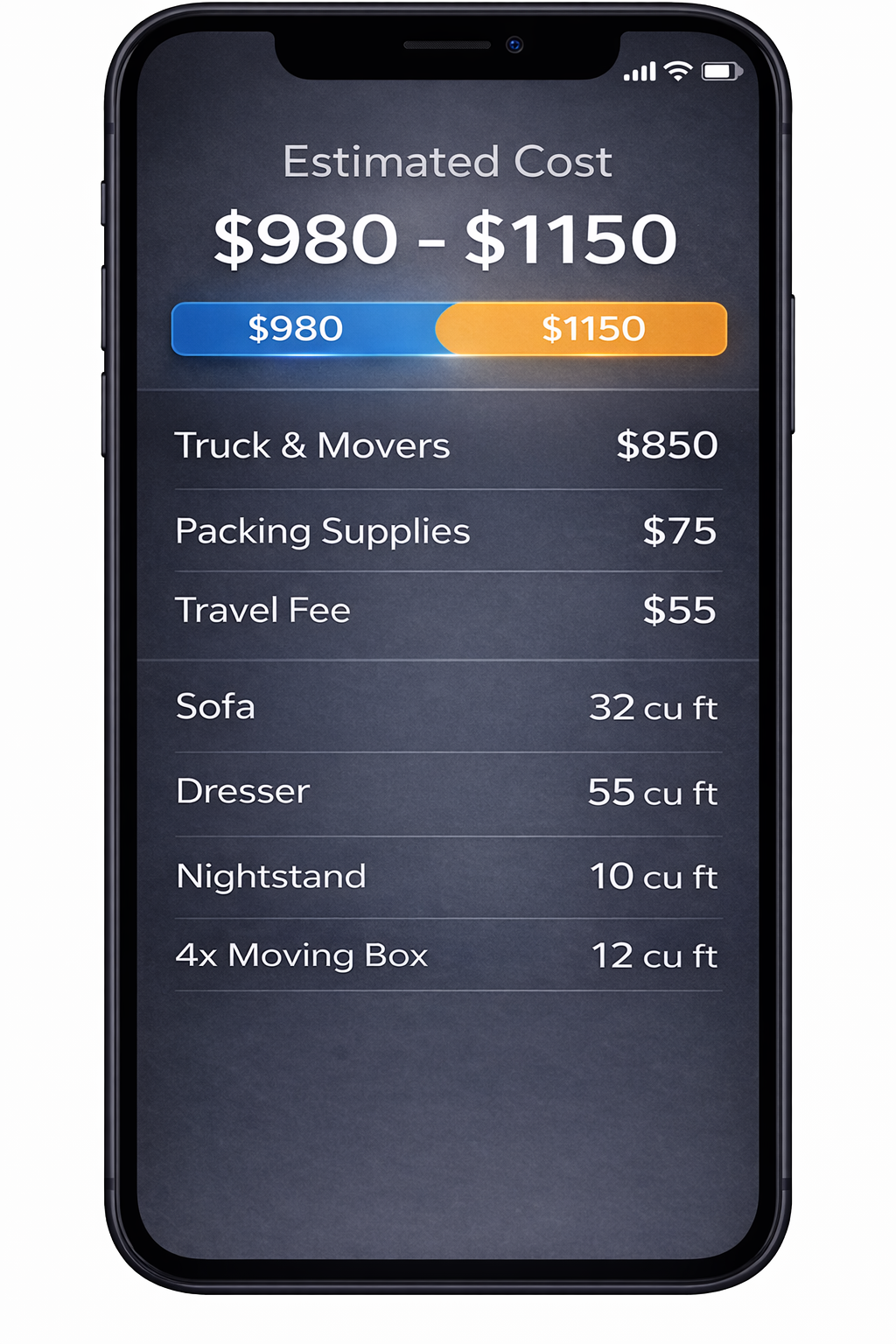
2. AI Detects Your Items
We identify your items and calculate volume for a clearer estimate.
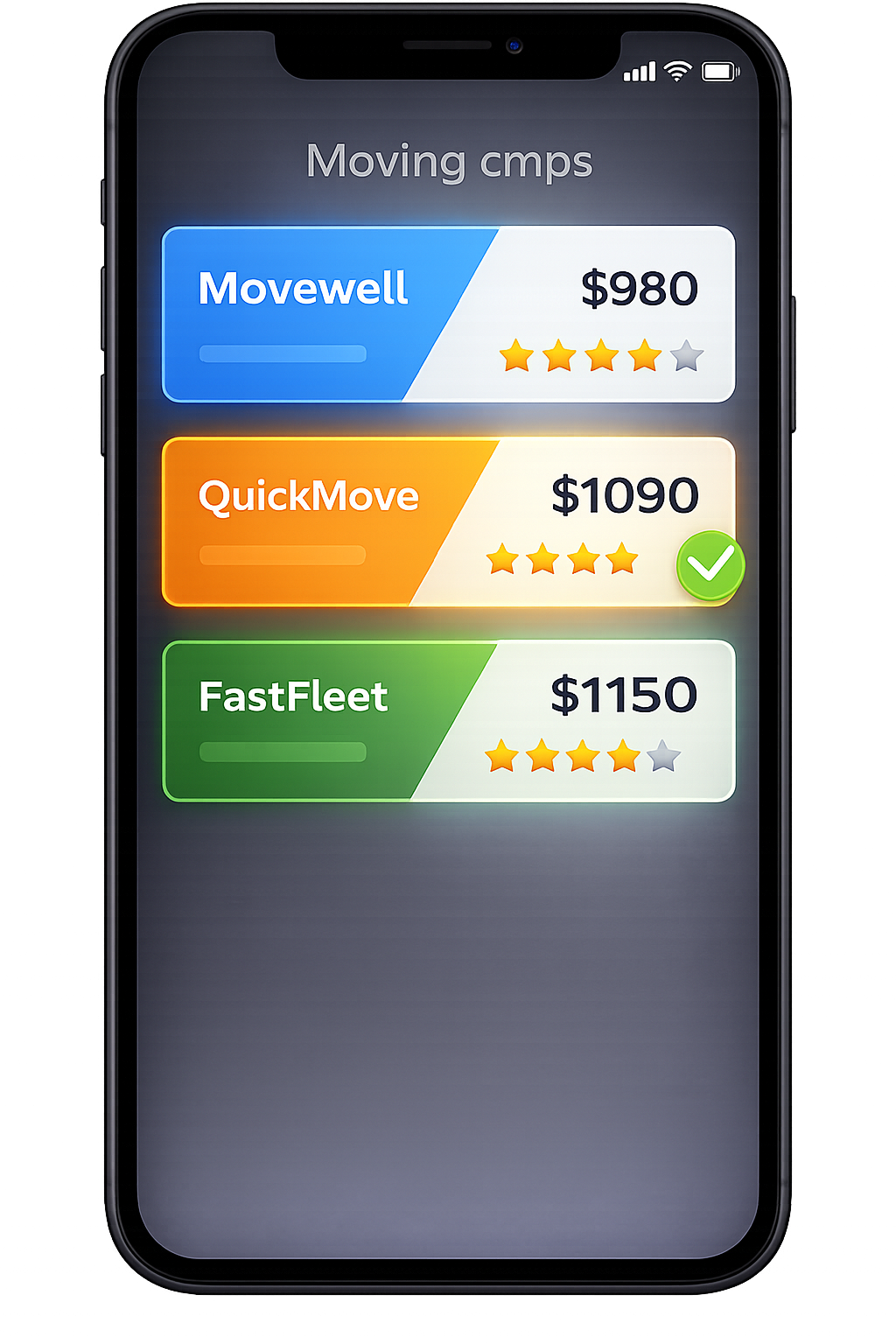
3. Compare Multiple Quotes
Compare mover quotes for Chicago, IL from the same scanned inventory.
Frequently Asked Questions
How is this Chicago long distance movers page different from a general Chicago quotes or cost page?
This page is specifically about interstate and long-distance moves that start in Chicago. It explains: How common Chicago–to–other‑state routes behave (Chicago–New York, Chicago–Dallas, Chicago–Denver, Chicago–Atlanta, and cross‑country lanes) How Chicago-specific factors like winter weather, freight elevators in the Loop, alley loading, and walk‑up stairs influence long-distance pricing and delivery windows How to use one AI scan of your Chicago home across national interstate tools and mover comparisons A general Chicago quotes page would focus on how to collect quotes (local and long distance) but wouldn’t go as deep on route behavior or cross‑state planning. A generic cost page might describe typical local costs without distinguishing in-state from outbound interstate lanes. Internal links and headings on this page are tuned to phrases like “long distance movers in Chicago” and “Chicago interstate routes” to keep its purpose distinct from local-only or generic Chicago moving content.
What long distance routes from Chicago does MoveCost support?
MoveCost can support virtually any U.S. route that starts in the Chicago area. Popular examples include: Chicago → New York City / New Jersey / Northeast Chicago → Boston / Philadelphia / Washington, DC Chicago → Dallas / Austin / Houston and other Texas cities Chicago → Denver / Front Range Colorado Chicago → Atlanta / Southeast metros Chicago → West Coast (Los Angeles, San Francisco Bay Area, Seattle, Portland) You enter your specific origin (for example, a Loop condo, a Lakeview walk‑up, or a Jefferson Park house) and your exact destination city and state. Long distance movers that run those lanes see your AI inventory and access notes and return route‑specific estimates for your move.
How does winter weather in Chicago affect long distance moving estimates?
Winter is a reality in Chicago and along many outbound routes. Snow and ice can: Slow down loading and unloading at your Chicago home, especially if sidewalks, alleys, and stairs are icy Affect traffic on interstates like I‑90/I‑94, I‑55, and I‑80 as trucks head toward your destination Influence which days movers consider realistic for pickup and linehaul When you indicate a winter move in MoveCost, movers factor in: Extra time for safe handling on stairs, sidewalks, and loading zones Potential weather‑related routing and timing adjustments on your lane That doesn’t automatically mean your price will be higher, but it does help you see more realistic delivery windows and staffing plans for long distance moves leaving Chicago in colder months.
Can the same AI scan of my Chicago home be used for both local and long distance movers?
Yes. The same AI-generated inventory of your Chicago home works across: Local/short‑distance tools (for example, a Chicago‑focused local movers or cost page, or Local Moving Cost Calculator Near Me) Long distance / interstate tools like this page, the State to State Moving Cost Calculator Online, and Moving Cost Calculator by State and City Comparison and no‑phone‑call hubs such as Instant Moving Quotes Without Phone Calls and Compare Moving Company Quotes Instantly Online That means you can: 1. Scan once in your current Chicago home. 2. Explore what it would cost to move locally, regionally, or out of state. 3. Decide which path you want before you book—with all estimates anchored to the same, accurate inventory.
Do I still need an in-person estimate in Chicago if I use MoveCost for long distance planning?
For many everyday interstate moves—1–3 bedroom homes, standard furniture, and typical building access—an AI-based inventory plus detailed access notes can give movers enough detail to provide strong estimates without an in‑person visit. Situations where a mover might still recommend an in‑person or live video walkthrough include: Very large homes (4+ bedrooms with extensive storage areas) Unusual items (pianos, very large aquariums, heavy workshop machinery, complex art installations) Highly restricted or complex access (multiple elevators, very tight courtyards, special loading arrangements) Even then, your MoveCost inventory serves as the baseline: movers arrive (physically or virtually) already knowing which rooms exist and what’s in them. That tends to make any additional walkthrough faster and more focused.
How does MoveCost get paid if it’s not a Chicago moving company?
MoveCost is a moving estimate and comparison platform, not a carrier. It doesn’t operate trucks or crews. The platform typically makes money through software or referral arrangements with moving companies, not by marking up your quote. You: Use the AI scan and comparison tools without paying MoveCost directly for basic planning See offers and estimates from movers that agree to fair, transparent pricing rules Pay the mover you choose under their terms when you decide to book That separation lets this Chicago long‑distance movers page focus on helping you understand your options rather than steering you toward one specific provider.