
Scan Your Home. Know Your Moving Volume and Move Size in Minutes.
MoveCost.ai turns a quick phone scan into a precise moving volume estimate in cubic feet, then helps you match that volume to the right truck size, crew, and planning tools—so you don’t under‑ or over‑book your move.

Moving Volume Estimation & Move Size Calculator — Scan Your Home for Cubic Feet & Truck Size | MoveCost.ai
This Is the Moving Volume Estimation & Move Size Calculator—Not the Main Cost Hub
Use it when you’re asking “How big is my move in cubic feet?” and “What truck and crew do I really need?” Then feed that volume into cost and quote tools. MoveCost.ai has calculators for costs, quotes, cities, stairs/elevators, and home sizes. This page is different: it’s the dedicated moving volume estimation and move-size calculator. Here’s how it sits in the network: • AI Moving Cost Calculator Online Free • Role: primary cost hub and scan engine. • Question it answers: “What should my move cost for this route?” • Connection: it uses your volume and inventory as one of its inputs. • This page – Moving Volume Estimation & Move Size Calculator • Role: volume and move-size specialist. • Questions it answers: “How many cubic feet am I moving?”, “What truck size is right?”, “Do I need 2 movers, 3, or more?”, “Will one trip be enough?” • How other tools use it: your cubic‑feet estimate and inventory flow straight into cost, route, and quote pages. • Local Moving Cost Calculator Near Me • Role: local pricing for short, in‑metro routes. • Question it answers: “Given my volume and local distance, what will a nearby move cost?” • State to State Moving Cost Calculator Online & Moving Cost Calculator by State and City • Role: interstate and route pricing. • Questions they answer: “What will it cost to move this volume from State A/City X to State B/City Y?” • Moving Cost Calculator for 3 Bedroom House & Average Cost to Move a 4 Bedroom House Cross Country • Role: home-size planning. • They use your volume to explain typical truck sizes, crew counts, and budget bands for bigger homes. • Moving Cost Calculator Including Stairs and Elevator • Role: access pricing. • It takes your volume and adds the complexity of walk‑ups, elevators, and long carries. • Quotes & city pages (for example, Moving Quotes in Miami, Long Distance Movers from Miami, Cheapest States to Move to From New York, Moving Quotes in Chicago, Moving Cost in Chicago) • Role: real‑world examples and offers. • They rely on your volume and inventory to make quotes comparable. Use this page when you want to separate “How big is my move?” from “What will it cost?” Once you know your moving volume, every other MoveCost tool has a clearer starting point.
Stop Guessing Truck Size. Let AI Measure Your Move for You.
Accurate moving volume estimation is what keeps you from booking the wrong truck, too few movers, or too many trips. Most people either over‑estimate their move and pay for more truck and labor than they need, or under‑estimate and end up with overflow, extra trips, or last‑minute scrambling. With MoveCost.ai you: • Walk through your home once with your phone • Let AI detect furniture, boxes, and bulky items • Get a moving volume estimate in cubic feet and a rough move-size category (for example, “small apartment”, “typical 2BR”, “full 3BR home”) That volume becomes the foundation for: • Choosing the right truck size (or container size) • Deciding whether you likely need 2 movers or 3+ • Understanding if your move can be done in one trip or multiple • Feeding clean data into cost and quote calculators later on Prevent overflow on move day Avoid paying for empty space Match effort to reality
How Moving Volume Estimation Changes Truck Size, Number of Movers & Trips
Your volume estimate isn’t just a number—it’s how you decide what equipment and crew make sense for your move. Movers and truck rental companies think in cubic feet and weight, not just bedrooms. Moving volume estimation bridges that gap for you. When MoveCost.ai scans your home, it outputs: • A cubic‑feet estimate (for example, 250 ft³, 600 ft³, 1,000 ft³+) • A rough move-size band (“small apartment”, “typical 2BR”, “3BR+ home”) • A structured inventory you can edit That maps to practical decisions like: • Which truck size or container type is appropriate • Whether 2 movers are enough, or 3–4 will realistically finish in one window • Whether your move is likely a single-trip job or will realistically take multiple runs (for certain DIY setups) Below are illustrative, not guaranteed, examples of how volume bands often align with typical capacity planning: Small moves (~150–350 ft³) Medium moves (~350–800 ft³) Large moves (~800–1,400+ ft³)
From Room Scan to Moving Volume and Move Size in 3 Steps
Designed to feel like a quick home tour, not a math exercise. You don’t need to measure every piece of furniture. The volume engine uses the same AI inventory that powers our cost and quote tools, but focuses on how much space your belongings occupy.
How Different Home Types Use Moving Volume Estimation
Studios, 2‑bedroom apartments, and 3‑bedroom houses all benefit from knowing their true volume—just in different ways. Once you have a cubic‑feet estimate, you can make better decisions about trucks, crews, and which cost tools to use next. Here’s how common move types apply moving volume estimation: Studio or Light 1BR Apartment Typical 2BR Apartment 3BR+ House with Garage/Patio
Use Your Volume Estimate to Lock In Truck, Crew & Trip Strategy
A clear cubic‑feet number lets you make concrete planning decisions instead of rough guesses. Once you know how many cubic feet you’re actually moving, you can treat move planning like a set of choices instead of a shot in the dark. With your moving volume estimate, you can: • Choose a truck or container size with confidence • If your scan shows you’re well under a truck’s capacity, you can step down a size or consider a shared or container option. • If you’re close to the upper limit, you can step up one size or plan for a second trip if you’re doing a DIY move. • Match crew size to your actual workload • A small volume with easy access may be fine with 2 movers. • A medium or large volume with stairs/elevators often benefits from 3–4 movers so the move doesn’t run into after‑hours windows or building limits. • Estimate how long the day will really take • Volume + access help you and movers see whether your job is likely a quick morning, a half‑day, or an all‑day project. • Sequence complex moves • If you’re combining a home with a storage unit, you can break out how much volume comes from each and decide whether they should be done in one truckload, two trips, or even on different days. This section is here so search engines and users alike understand that this page is about volume and move-size planning, not just another general cost calculator. It’s where you answer, “What does my move look like in space and effort?” before you answer, “What will it cost?”
Send Your Moving Volume Estimate to Cost Calculators, Quotes, and Guides
One scan, one volume estimate, many tools. Your moving volume estimate doesn’t live in a silo. It becomes the shared input for other MoveCost.ai experiences: • AI Moving Cost Calculator Online Free • Uses your volume + route + access level to estimate what your move should cost. • Local Moving Cost Calculator Near Me • Combines your volume with local distance and traffic expectations for realistic in‑metro pricing. • State to State Moving Cost Calculator Online and Moving Cost Calculator by State and City • Apply your volume estimate to specific state and city pairs so you can see how the same move size behaves across multiple routes. • Moving Cost Calculator for 3 Bedroom House and Average Cost to Move a 4 Bedroom House Cross Country • Compare your scanned volume with typical patterns for those home sizes to understand whether your home is lighter or heavier than average. • Moving Cost Calculator Including Stairs and Elevator • Uses your volume as the starting point and layers on access complexity: stairs, elevators, and long carries. • Quotes and city/origin pages • Pages like Moving Quotes in Miami, Long Distance Movers from Miami, Moving Cost in Chicago, Moving Quotes in Chicago, and Cheapest States to Move to From New York all reference your volume and inventory to standardize quotes and route comparisons. That’s why we treat this page as the volume and move-size hub. Once your cubic‑feet estimate is set, every other tool has better inputs—and your comparisons become about real trade‑offs instead of mismatched assumptions.
Volume Estimation That Keeps Your Estimates and Reality Closer Together
When inventory and cubic feet are accurate, time and cost have less room to drift. Under‑estimating your move size is one of the main reasons quotes end up lower than final bills. Volume‑first planning doesn’t remove every unknown, but it removes a big one. By centering your move around a realistic moving volume estimation, you: • Give movers a clearer scope to staff and schedule around • Make apples‑to‑apples comparisons easier across multiple quotes • Reduce the chance that an “estimate” was really just a placeholder guess This page exists to make that scope visible before you open any cost tool or talk to any mover. Less guesswork, more planning Fewer truck and crew surprises Cleaner budget conversations
How It Works
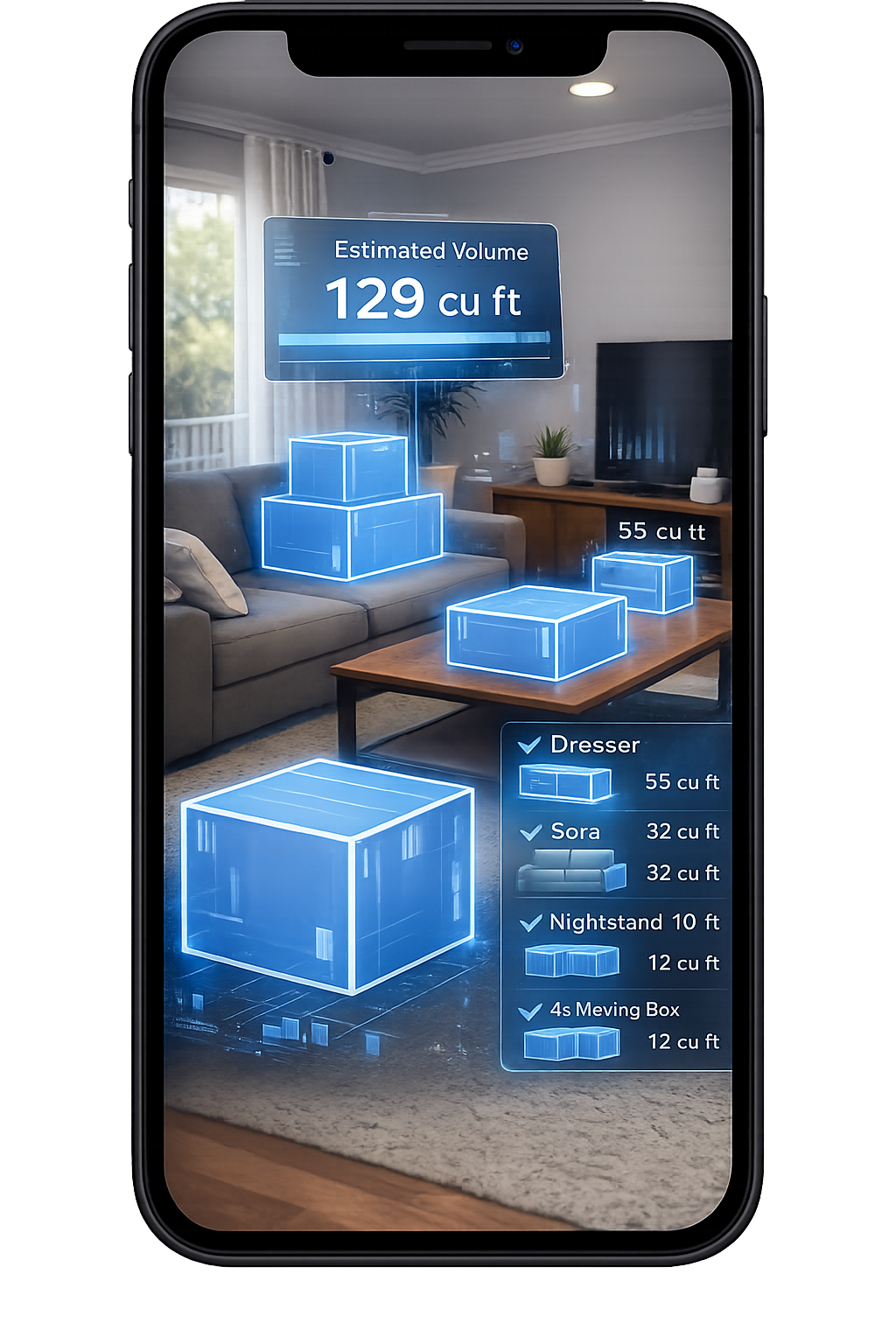
1. Scan Your Room With Your Phone
Walk around your space and scan your items in seconds.
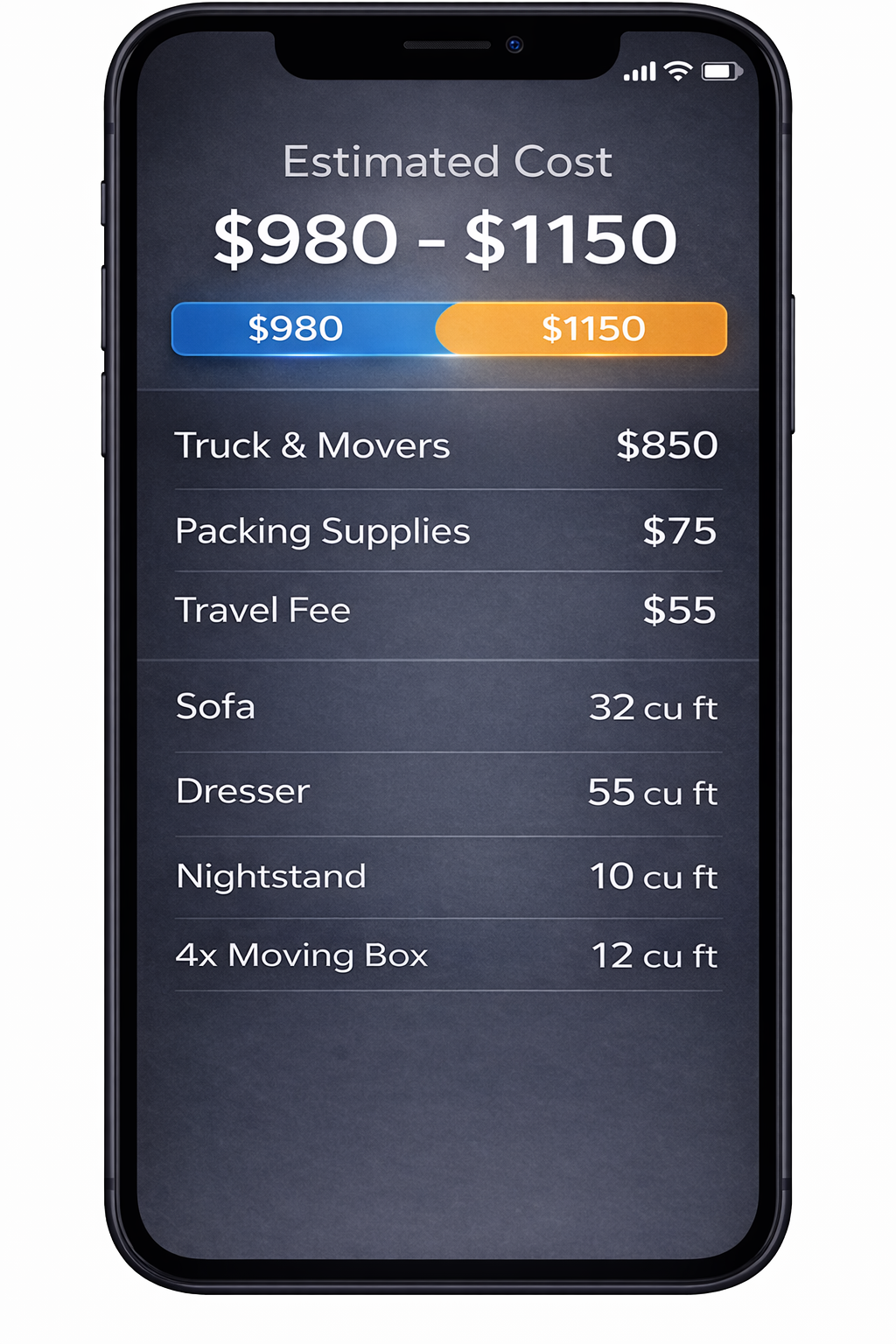
2. AI Detects Your Items
We identify your items and calculate volume for a clearer estimate.
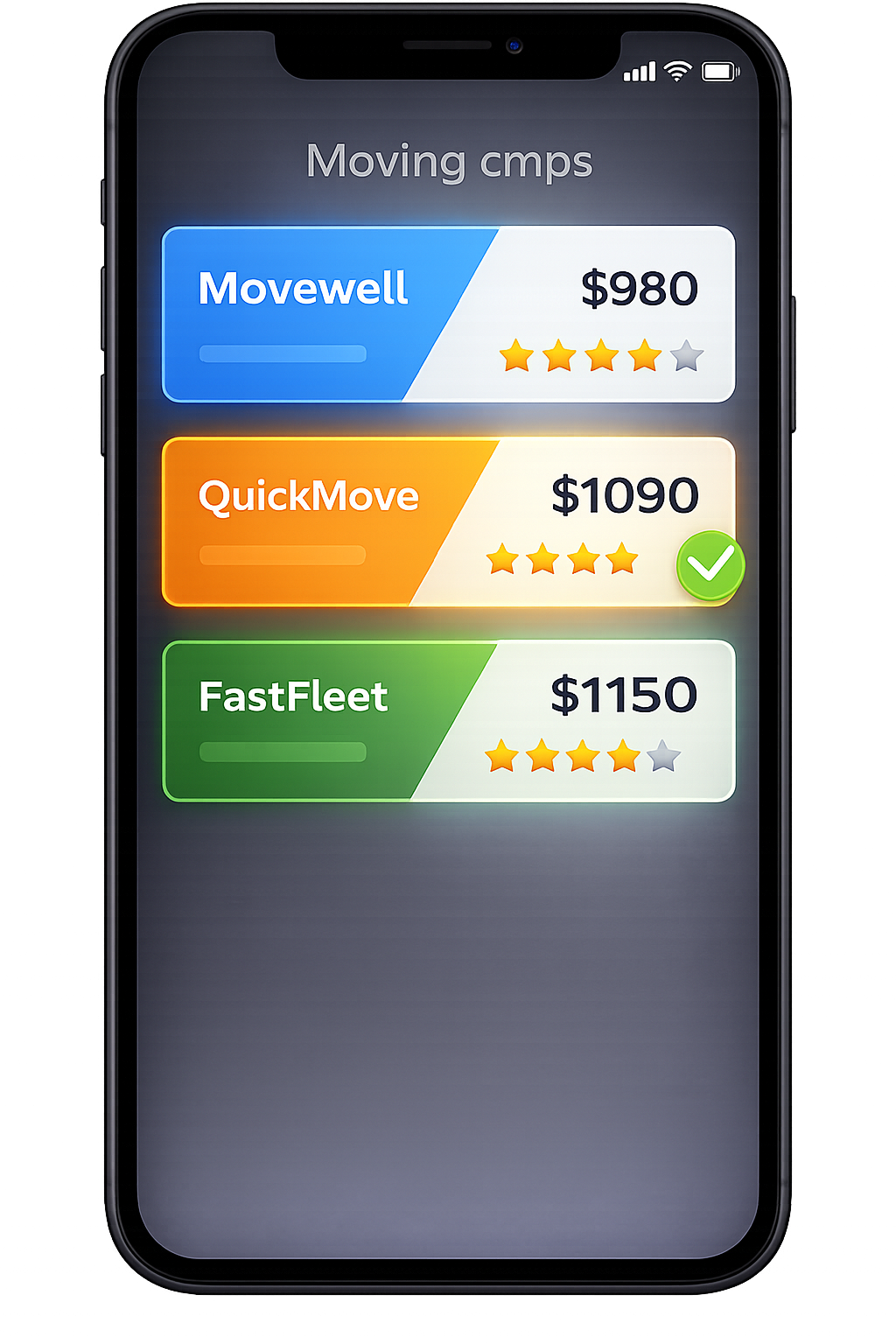
3. Compare Multiple Quotes
Compare verified mover quotes from the same scanned inventory.
Frequently Asked Questions
What is moving volume estimation and why does it matter?
Moving volume estimation is the process of estimating how much space your belongings will take up—usually measured in cubic feet. Movers and truck rental companies use volume (and related weight estimates) to decide: What size truck or container to send How many movers they should schedule How long loading and unloading are likely to take If you under‑estimate your move size, you risk overflow, extra trips, or rushed decisions on move day. If you over‑estimate, you may pay for more capacity than you need. Using an AI scan to estimate volume helps right‑size trucks and crews before you start comparing costs.
How is this moving volume estimation page different from your main AI moving cost calculator?
The AI Moving Cost Calculator Online Free is the primary cost hub—its job is to take your inventory, volume, route, and access level and turn them into cost ranges. This page is the volume and move-size specialist. Its job is to: Turn your scan into a cubic‑feet estimate Suggest appropriate truck size and crew configurations Help you understand whether your move is small, medium, or large for planning purposes Give you a move-size label that other tools reuse Once you know your moving volume here, you can click into the AI cost hub, local calculators, state‑to‑state tools, stairs/elevator, home‑size, and city/origin pages with a much clearer starting point. The same inventory and volume are reused; this page just focuses on the “how big is my move?” question.
Do I need to measure my furniture to get a volume estimate?
No. You don’t have to measure each sofa, table, or wardrobe with a tape measure. When you scan your home with your phone, MoveCost.ai uses computer vision to: Recognize common items (sofas, beds, dressers, tables, TVs, box stacks, etc.) Approximate their typical dimensions and how they stack in a truck Estimate total cubic feet based on your scanned layout You can refine the inventory (add/remove items, flag unusual sizes), but the heavy lifting of measurement is handled by the AI.
How accurate is the moving volume estimate compared to a traditional in‑home survey?
For many standard homes and apartments, AI‑based moving volume estimation can land in a similar range to a traditional visual survey—especially if you scan all rooms, storage spaces, and access paths carefully. Real‑world volume can still differ if: You add or remove items after scanning Certain spaces (like a storage unit or attic) weren’t scanned or listed You have unusually large, custom, or fragile items that behave differently than typical furniture However, starting from an AI inventory usually produces a much closer approximation than guessing by room count alone, and it gives movers a clearer baseline to work from.
How does my volume estimate affect the number of movers I should book?
Volume is one of the main inputs movers use when deciding how many people to send. In simple terms: Smaller volumes in easy‑access homes may be manageable with 2 movers in a shorter window. Medium volumes (like fuller 2BRs) often benefit from 2–3 movers, especially if there are stairs or elevators. Larger volumes (3–4BR homes with garage/patio items) are often smoother with 3–4 movers to avoid very long days. Your AI volume estimate, combined with access notes (stairs, elevators, long carries), helps movers decide which crew size can realistically complete your move in one day or within your building’s allowed hours. Cost calculators then layer hourly rates or linehaul pricing on top of those crew plans.
Can I use the same moving volume estimate for local and long‑distance moves?
Yes. The same volume and inventory are relevant whether you’re moving across town or across the country. What changes between local and long‑distance moves is: How much of the price comes from labor time vs distance and fuel How movers structure delivery windows and shipment types Which tools you use after volume estimation (local cost calculators vs state‑to‑state and city/route tools) Once you have a cubic‑feet estimate here, you can send it to local and long‑distance calculators and compare how each move scenario behaves without re‑entering your items.
What if I declutter or buy new furniture after I scan—do I need a new volume estimate?
If your move changes significantly—selling multiple large pieces, adding a full room of items, or consolidating a storage unit you forgot—then it’s worth updating your inventory and refreshing your volume estimate. You can either: Run a quick follow‑up scan for the affected rooms, or Manually adjust items in your inventory (remove what’s gone, add what’s new) Small changes (a few boxes more or less) usually don’t require a full re‑scan, but anything that materially changes how full a truck will be is worth updating before you shop for cost estimates or quotes.
How does this page help search engines understand that it’s about move size and volume, not just generic moving costs?
The content and structure on this page are deliberately focused on moving volume estimation and move-size planning: The title and headings use phrases like “moving volume estimation”, “move size calculator”, “cubic feet”, “truck size”, and “number of movers”. Sections explain how volume maps to trucks, crews, and trips, rather than talking primarily about dollars. Internal links and cluster‑role copy explicitly position this URL as the volume & move-size hub under the main AI cost calculator, not as another generic quote or cost page. Other pages—AI hub, local cost, state‑to‑state, 3‑bedroom, 4‑bedroom, stairs/elevator, Miami, Chicago, cheapest‑states, New York outbound—link here when they mention move size or volume, reinforcing that this is the canonical place for that topic.