
Realistic Moving Costs in Las Vegas, NV — Before You Book a Truck
Use this page as your Las Vegas moving cost hub. See typical prices for local moves in the Valley and popular routes out of Las Vegas, then use AI to scan your home and compare real quotes from professional movers.

moving cost in Las Vegas, NV
Typical Moving Costs in Las Vegas, NV
This page is your pricing hub for moving cost in Las Vegas. It pulls together typical ranges for local moves in the Valley plus long-distance examples, so you can sanity‑check any quote before you book. Local apartment and small home moves within the Las Vegas Valley These rough ranges describe what many people end up paying for local moves inside the metro (Spring Valley, Paradise, Henderson, North Las Vegas, Summerlin, Enterprise, etc.) with a professional crew. They assume basic loading/unloading and standard local drive times. • Studio or small 1‑bedroom apartment Common routes: Paradise → Spring Valley, Downtown → Arts District, UNLV area → Maryland Parkway • Many local moves land in the roughly $350–$750+ range. • This usually covers 2 movers, a truck, and a few hours of labor and drive time. • Standard 1‑bedroom apartment Common routes: Spring Valley → Henderson, Green Valley → Silverado Ranch, central Las Vegas → North Las Vegas • Many moves fall somewhere around $400–$900+. • You’ll be toward the higher end if the building has long walks, tight stairs, or slow elevators. • 2‑bedroom apartment or small house Common routes: North Las Vegas → Centennial Hills, Enterprise → Southern Highlands, Summerlin → Henderson • It’s common to see totals in the roughly $800–$1,500+ range. • Access, stairs, and how well you’re packed can push you up or down within that band. • 3‑bedroom house Common routes: Henderson → Summerlin, Mountains Edge → Inspirada, Aliante → Green Valley • Standard local moves often fall somewhere around $1,200–$1,800+. • Larger garages, heavy outdoor furniture, or pool tables can add time and cost. These bands are not guarantees or offers from MoveCost.ai or any mover. They’re directional examples based on common Las Vegas scenarios so you can see if a quote is unusually low or high for your situation. Quick comparison: simple vs. complex Las Vegas moves Even within the same home size, two Las Vegas moves can be priced very differently: • Simpler local move (often closer to the lower end of the ranges above) • Ground‑floor or elevator unit with parking close to the entrance • No special building rules, easy truck access • Most items boxed and ready to go • More complex local move (often closer to or above the upper end) • Walk‑up with multiple flights of stairs or slow elevator • Long carries from a parking lot or garage • Oversized items (sectionals, gym equipment, safes, pool tables) How these Las Vegas cost ranges should be used These are not quotes—they’re Las Vegas‑specific examples to help you sense‑check any moving estimate you see. Your actual price depends on: • The exact addresses and driving distance in the Las Vegas area • Inventory size and whether you’re in a furnished vs. unfurnished place • Building type (walk‑up, elevator, Strip‑adjacent condo, gated community, etc.) • Move date and time (end‑of‑month Saturday vs. mid‑week morning) If you want to move from rough local ranges into a personalized moving estimate Las Vegas based on your own furniture, you can start with the main AI moving cost calculator online free tool and then compare quotes from multiple local movers.
Example Moving Costs From Las Vegas to Nearby Cities
Long‑distance moves in or out of Las Vegas are usually priced differently from quick hops around the Valley. Instead of a simple hourly rate, movers look at distance + how much you’re moving + route details. Below are common scenarios for people leaving Las Vegas. These are illustrative examples, not guaranteed prices, designed to show you ballparks before you request detailed moving quotes Las Vegas through MoveCost.ai. Las Vegas to Phoenix, AZ (I‑11 / US‑93 / I‑10 corridor) • For a modest 1–2 bedroom apartment or small house with full‑service movers, many people see totals in a low‑to‑mid four‑figure range, depending on volume and services. • A smaller inventory (lightly furnished 1‑bedroom leaving a central Las Vegas high‑rise) is usually at the lower end; a fully furnished 2–3 bedroom home from Henderson or Summerlin with packing included is higher. • Travel time, overnight parking, and summer heat along the route can all influence how movers schedule and staff your job. Las Vegas to Los Angeles area (Southern California) Many Las Vegas residents move to or from the LA metro—Los Angeles, Orange County, or the Inland Empire. • A typical 1–2 bedroom apartment from Las Vegas to LA often falls somewhere in a low‑to‑mid four‑figure range with full‑service movers. • Larger homes or added services (packing, unpacking, crating) can move you into a higher four‑figure or above band. • Moves into dense LA neighborhoods or into elevator buildings can run on the higher side compared with similar mileage into more suburban areas. Las Vegas to nearby Western states These examples are directional and meant to show that distance and route profile matter as much as inventory: • Las Vegas → Salt Lake City or Denver: More mileage and higher‑elevation routes generally mean more driver time and higher line‑haul costs than Phoenix or Southern California, so similar inventories may sit in a higher four‑figure band than a Las Vegas → Phoenix move. • Las Vegas → Pacific Northwest (Portland, Seattle): Even with a moderate inventory, these routes layer on significant distance, so total cost is usually meaningfully higher than a straightforward Las Vegas → Phoenix move. Because so many factors stack up—inventory, season, access, and exact route—the best way to get a grounded long‑distance moving company cost Las Vegas is to: 1. Scan your home with AI so movers can see what you’re actually taking. 2. Enter your Las Vegas address and your new city. 3. Compare multiple long‑distance movers side‑by‑side on MoveCost.ai to see how each treats fuel, mileage, and delivery windows. If you’re still early in planning, you can also use our state to state moving cost calculator online and moving cost calculator by state and city to see how a Las Vegas origin compares with other routes, then return to this Las Vegas page for city‑specific context.
How Distance and Route Shape Your Las Vegas Moving Cost
In Las Vegas, distance is only part of the story, but it’s still a key driver of both local and long‑distance pricing. Inside the Valley: hourly pricing and traffic Most local movers in Las Vegas charge by the hour. The clock typically starts when the crew leaves their yard and stops once they’re finished at your new place. That means: • Short hops like Paradise → Enterprise, Henderson → Green Valley, or Summerlin → Spring Valley can be relatively quick and, in many cases, closer to the lower end of the local cost bands if traffic cooperates. • Moves that cross high‑traffic zones—near the Spaghetti Bowl, Allegiant Stadium, or the resort corridor—can run longer if your crew gets stuck during busy times. Because time is money in an hourly model, choosing a route and time of day that avoids the heaviest congestion can keep a 4‑hour move from turning into a 6‑hour bill. Out of Las Vegas: mileage and route complexity Once you leave the metro area, estimates focus more on: • Total mileage from your Las Vegas address to the destination city • How much of the route is straightforward interstate vs. slower highways • Whether your shipment can be combined with others going in the same direction • Seasonal factors such as extreme heat or mountain passes on Western routes Two moves with similar inventories can be priced differently if: • One follows a direct interstate route (for example, Las Vegas → Phoenix). • The other crosses multiple states with more complex terrain (for example, Las Vegas → Denver or Portland). Route-aware estimates with AI When you build a moving estimate Las Vegas on MoveCost.ai, the AI uses your starting and ending addresses, typical drive times, and your scanned inventory so movers can respond with route‑aware prices instead of generic national averages. You can start with a local moving cost calculator near me for neighborhood‑to‑neighborhood moves or the state to state moving cost calculator online for interstate routes, then compare detailed quotes from movers that know those lanes.
How Much You’re Moving Matters Most — Use AI to Measure It
In a city where people regularly shift between furnished high‑rises near the Strip and larger homes in Henderson or Summerlin, the amount of stuff you have is usually the single biggest driver of your final bill. Real‑world Las Vegas inventory examples • A lightly furnished studio on Maryland Parkway with a bed, small sofa, and a few boxes can often be moved by a small crew in a few hours. • A 3‑bedroom house in Centennial Hills with a garage full of tools, patio furniture, and gym equipment is a much bigger job—more movers, more truck space, and more time. • A Strip‑adjacent condo with a mix of bulky furniture and fragile décor can take longer per item because of elevators, loading docks, and building rules. Traditional quote forms ask you to check boxes and guess how many items you have in each room. That’s where many Las Vegas moving cost estimates go off track, especially in furnished rentals or casino‑adjacent condos where it’s easy to underestimate what’s actually in the unit. MoveCost.ai replaces guesswork with an AI-based home scan: 1. Walk through your rooms with your phone. 2. The AI detects major items—beds, couches, tables, desks, appliances, outdoor pieces—and estimates the volume. 3. You add or remove items (for example, if you’re selling a sectional before leaving your Summerlin townhouse, or not taking your patio set from a Henderson backyard). Movers then see a detailed inventory and can price your moving company cost Las Vegas based on what they’re really hauling, not a rough estimate. This is especially important for: • Long‑distance moves where price is tied to weight or cubic footage • Moves involving heavier items like safes, pool tables, or large outdoor sets • Multi‑story moves where stairs and elevators add time per item Once you see your AI‑estimated volume, you can decide which items are truly worth paying to move versus selling or donating before you go. If you want to see how your inventory compares to typical homes, you can also explore tools like our moving cost calculator for 3 bedroom house and moving cost calculator including stairs and elevator for more detailed scenarios.
Desert Heat, Seasonality, and Timing Your Move in Las Vegas
Unlike snow‑bound cities, Las Vegas moving cost is shaped by desert heat, tourism peaks, and local leasing patterns. Heat and crew speed From late May through August, temperatures often hit triple digits. Crews must pace themselves and take breaks, especially in walk‑up buildings and when loading a hot truck in the afternoon. The result: • A move that might take 4–5 hours in March can take longer in July, which affects hourly pricing. • Afternoon moves from areas like North Las Vegas or Inspirada into the city core can be slower due to both heat and traffic. • Moves that require long outdoor carries—such as from a distant parking lot at a large complex—are especially sensitive to mid‑day heat. Heat alone doesn’t add a specific “surcharge” in most cases, but it can indirectly increase your final cost by stretching labor time. Month and day of week Across the Valley, you’ll usually see: • End‑of‑month and weekends: often busier and sometimes more expensive because leases around UNLV, the Strip, and major apartment communities turn over at the same time. Peak demand can mean fewer open time slots and higher hourly minimums with some movers. • Mid‑week, mid‑month: often easier to schedule and sometimes more budget‑friendly, especially for local moves within Henderson, Summerlin, or North Las Vegas. Events and Strip‑area congestion When large conventions, concerts, or big game weekends are in town, traffic and access around the resort corridor tighten up. If your move touches a condo near the Strip or a building close to major venues: • Loading docks and service elevators may be busier and harder to reserve. • Travel time for the truck can be unpredictable during event load‑in or load‑out windows. On MoveCost.ai, you can generate multiple moving quotes Las Vegas for different days and times—e.g., last Saturday of the month vs. a mid‑week morning. That lets you see how shifting your move date can change your expected cost before you lock anything in, using tools like the local moving cost calculator near me for short hops and the AI moving cost calculator online free for bigger changes.
Casinos, Gated Communities, and High‑Rises: How Access Changes Your Price
Two Las Vegas moves with the same furniture can be priced very differently because of access and building rules. Casino‑adjacent and Strip‑area buildings If you’re moving into or out of a condo near the Strip or close to major casinos: • Movers may need to use specific loading docks and service elevators. • Security, front desk, or HOA staff might require certificates of insurance or pre‑approved time windows. • Long hallways and parking garages add walking time for every item. All of that can stretch out an otherwise simple move, which is why many Strip‑area moves fall on the higher end of typical moving cost in Las Vegas for the same inventory. Gated communities and master‑planned neighborhoods In Henderson, Summerlin, Southern Highlands, and other gated communities, movers often need: • Gate codes or visitor access ahead of time • To park in specific areas, which can lengthen carries from the truck to your door • To coordinate with HOA rules on truck size, parking duration, or time windows If a large truck can back close to your garage in places like Silverado Ranch or Mountains Edge, the crew will usually work faster than if they’re shuttling from farther away. Walk‑ups, elevators, and older complexes • Walk‑up apartments with multiple flights of stairs in central Las Vegas can slow crews down. • Older buildings with narrow stairwells or tight corners may require extra maneuvering or additional crew members for heavy pieces. • Newer luxury buildings may have strict elevator reservation windows—missing a slot can mean unexpected waiting time. When you build your moving estimate Las Vegas on MoveCost.ai, we capture these details upfront—floor level, stairs, elevator access, gate codes, and parking notes. You can even use the AI scan and photos to give movers a better sense of your situation so any moving company cost Las Vegas you see already reflects your building type, not just your furniture list. For additional context on how access changes pricing, you can explore our moving cost calculator including stairs and elevator tool as well.
Compare Real Moving Company Costs in Las Vegas With One Scan
Most people in Las Vegas don’t move often enough to feel confident reading moving contracts or judging whether a quote is fair. MoveCost.ai is built to make that easier. Here’s how it works for Las Vegas moves: 1. Scan your home with AI • Walk through your apartment, condo, or house with your phone. • The AI identifies major items and estimates volume so movers can see what they’re bidding on. 2. Enter your Las Vegas and destination addresses • Whether you’re going from Spring Valley to Henderson or from a condo near the Strip to Phoenix, route and access details are baked into your request. 3. Get multiple moving quotes Las Vegas in one place • See how different movers price your job: hourly vs. flat rate, travel time, and what’s included (basic protection, simple assembly/disassembly, etc.). 4. Adjust and compare • Try a mid‑week date instead of a Saturday. • Remove items you plan to sell. • See how those changes affect your expected moving cost in Las Vegas before you commit. Instead of relying on a single ballpark number, you’ll see a realistic range of moving company cost Las Vegas options grounded in your actual home and route. When you’re ready, start your free scan and turn the Las Vegas price ranges on this page into live, bookable estimates. If you prefer to explore general tools first, you can start with the core AI moving cost calculator online free or go straight to compare moving company quotes instantly online, then come back to this Las Vegas cost hub when you’re ready to focus on local price expectations.
How It Works

1. Scan Your Room With Your Phone
Walk around your space and scan your items in seconds.
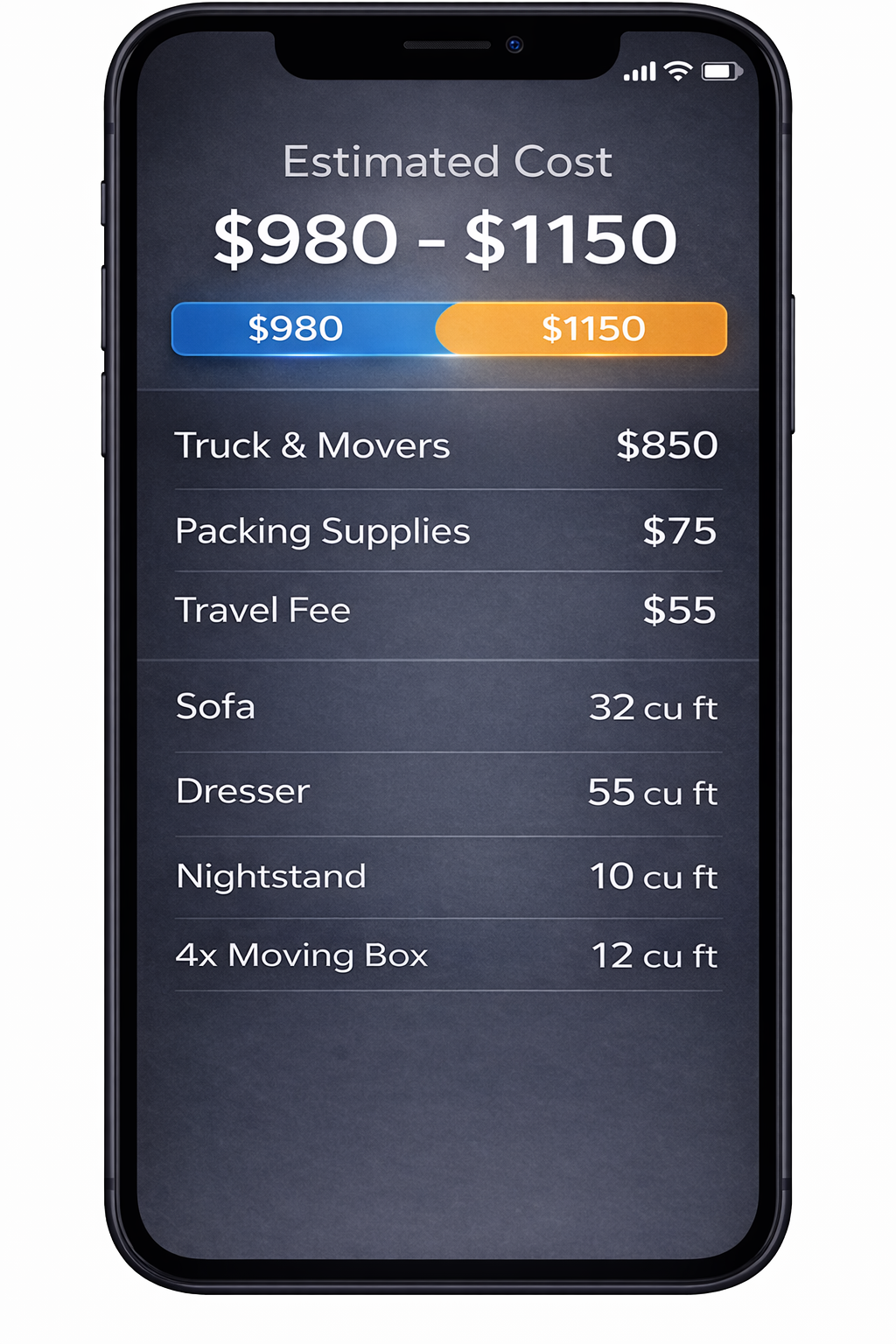
2. AI Detects Your Items
We identify your items and calculate volume for a clearer estimate.
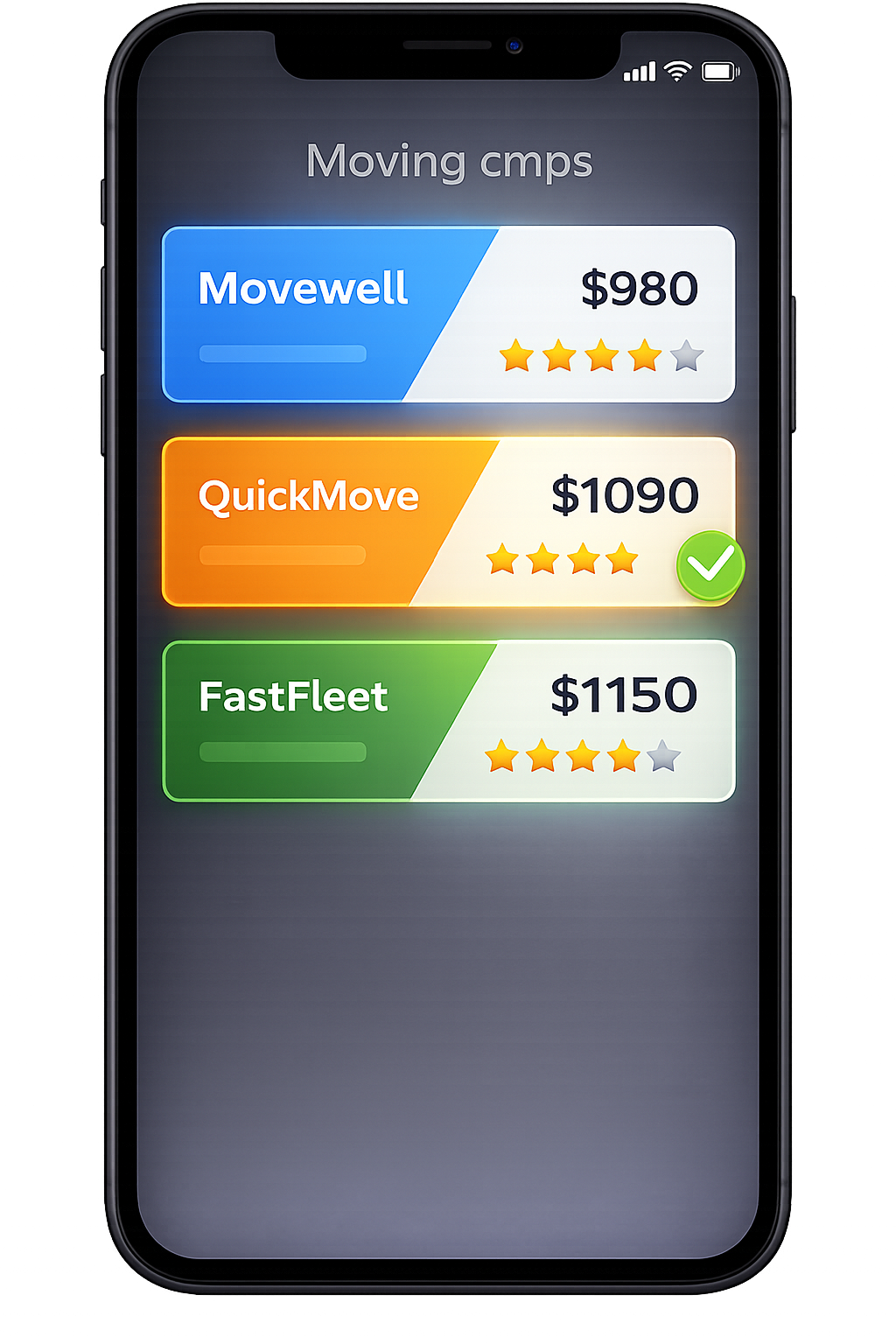
3. Compare Multiple Quotes
Compare mover quotes for Las Vegas, NV from the same scanned inventory.
Frequently Asked Questions
What is a typical moving cost for a one‑bedroom apartment in Las Vegas, NV?
For a standard one‑bedroom apartment move within the Las Vegas metro area, many people end up somewhere in the roughly $400–$900+ range with professional movers. You’ll be closer to the lower end if access is easy—ground floor or elevator close to parking, no long walks, no complicated building rules. You’ll be toward the higher end if you’re in a busy complex near the Strip, have slow elevators, long hallways, or multiple flights of stairs. Use MoveCost.ai’s AI scan to list what you’re moving and compare several local moving company cost Las Vegas quotes to see where your specific move is likely to land within (or outside) that range.
How much does it cost to move a 2‑ or 3‑bedroom home within Las Vegas?
For many 2‑bedroom apartments or small houses moved within the Las Vegas Valley, people often see totals in the roughly $800–$1,500+ band, while 3‑bedroom homes commonly fall somewhere around $1,200–$1,800+. Moves with easier access (driveway parking, few stairs, short carries) tend to sit near the lower end; larger homes with garages full of items, heavier furniture, or trickier access (gated communities, long walks, limited parking) can push higher. These ranges are directional, not promises. Scanning your home with MoveCost.ai and running a local moving cost calculator near me scenario gives you more tailored numbers before you compare mover quotes.
Do Las Vegas movers charge extra for casino‑adjacent or Strip‑area buildings?
Many movers don’t list a separate “casino” fee, but casino‑adjacent and Strip‑area buildings often take longer to work in, which affects the final cost. Service elevators, loading docks with check‑in procedures, limited parking, and long walks from the truck to your unit can all add time. Because most local Las Vegas moves are billed hourly, that extra time turns into a higher bill. When you request moving quotes Las Vegas through MoveCost.ai, note that your building is near the Strip and share access details so movers can account for that upfront instead of adding surprise time on moving day.
How does living in a gated community affect my moving cost in Las Vegas?
Gated communities in areas like Henderson, Summerlin, and Southern Highlands can influence your moving cost in Las Vegas because of access and parking rules. If movers can easily enter the gate, park close to your house, and load from your driveway, your move may stay closer to the lower end of local price ranges. If gate codes aren’t set up in advance, trucks have to park farther away, or there are narrow streets that limit where they can stop, crews spend more time walking and coordinating, which increases labor time. When using MoveCost.ai, include gate access details so movers can factor those logistics into their estimates and you can compare how different companies price the same situation.
What’s the best time of day and year to move in Las Vegas to avoid heat‑related cost increases?
In Las Vegas, the combination of summer heat and traffic can make afternoon moves slower and more expensive. To reduce the chance that heat will push your bill up, people often aim for: Morning start times, especially from late May through August, so crews can handle heavy items before the day’s peak temperatures. Spring and fall dates when possible, since moderate temperatures can help moves go faster. Mid‑week, mid‑month slots, which are usually less busy than end‑of‑month weekends when many leases turn over. When you build a moving estimate on MoveCost.ai, you can generate separate moving quotes Las Vegas for different days or time windows using tools like the local moving cost calculator near me, then compare how timing affects your expected cost.
How much does it cost to move from Las Vegas to Phoenix or Los Angeles?
Moves from Las Vegas to Phoenix or to the Los Angeles area are common routes, but prices vary based on how much you’re moving and what level of service you choose. A small, lightly furnished apartment may be at the lower end of a low‑to‑mid four‑figure range, while a fully furnished 2–3 bedroom home with packing and additional services will usually be higher. Mileage, fuel, and whether your shipment is combined with others all influence the total. The most reliable way to understand your own Las Vegas→Phoenix or Las Vegas→LA cost is to scan your home with MoveCost.ai and compare route‑specific moving company cost Las Vegas quotes from interstate movers that regularly run those lanes, using the state to state moving cost calculator online as a starting point.
Are local Las Vegas moves usually hourly or flat‑rate, and how does that change my total cost?
Many local moves in Las Vegas are billed by the hour, especially when you’re going from one neighborhood in the Valley to another. In an hourly model, your final moving cost depends heavily on how long the crew is on the job, which is influenced by access, stairs, elevator waits, parking distance, and how well you’re packed. Some movers also offer flat‑rate pricing for clearly defined jobs, but those rates are still based on estimated hours and inventory. With MoveCost.ai, you can scan your home and see both hourly‑style and flat‑rate moving estimate Las Vegas options side‑by‑side from different companies using our quote comparison tools.
How can I lower my moving cost in Las Vegas without cutting corners on safety?
There are a few levers that often reduce moving cost in Las Vegas while keeping your move safe: Limit what you move: Use an AI scan to see your total volume, then decide which bulky or low‑value items to sell or donate instead of paying to haul them. Improve access: Reserve elevators, clear hallways, and secure parking as close as possible to your door to cut down on walking time. Choose timing carefully: If your schedule allows, consider mid‑week, mid‑month dates and cooler morning time slots, especially in summer. Pack efficiently: The more organized and ready‑to‑load your boxes are, the more of your billable time is spent moving instead of packing. Running scenarios in the AI moving cost calculator online free and then comparing several moving company cost Las Vegas quotes lets you see how each of these changes affects your total before you decide.
Can MoveCost.ai help me check if a Las Vegas moving quote is reasonable?
Yes. This Las Vegas cost page gives you rough local and route‑specific ranges, and MoveCost.ai lets you test any single quote against multiple alternatives. You can scan your home, enter your addresses, and see several moving company cost Las Vegas estimates from different movers for the same inventory and dates. If the quote you already have is much higher or lower than comparable offers, that’s useful context as you decide whether to ask more questions, adjust your move details, or choose another company. Our moving estimate guide for first‑time movers also walks through how to read and compare estimate line items.