
Chicago Moving Cost: 2026 Price Ranges for Apartments, Condos & Houses
See what people actually pay to move in Chicago by neighborhood and home type, then use MoveCost.ai’s AI home scan to turn your own place into an accurate moving cost estimate before you book a crew.

moving cost in Chicago, IL
This Page Is Your Chicago Moving Cost Hub (Not a Quote Form, Not a Company List)
MoveCost has several Chicago pages that can look similar at a glance. Each has a specific job so they don’t compete with each other in search or confuse visitors. On this URL – Moving Cost in Chicago, IL – the focus is on price ranges and cost drivers: • What a typical local move inside Chicago might cost in 2026 • How costs change for different home sizes and neighborhoods • How stairs, elevators, parking, and timing move you up or down the range Related Chicago pages do different things: • Moving Quotes in Chicago, IL – built for requesting and comparing quotes once you’re ready to talk to movers. • Moving Company Cost in Chicago, IL – focuses on how different companies structure prices (hourly vs flat, fees, and policies) rather than raw ranges. National tools cover broader use cases: • AI Moving Cost Calculator Online Free – your main AI scan hub for any route. • Moving Cost Calculator by State and City – compares costs between specific city pairs (for example, Chicago → Naperville or Chicago → Milwaukee). • State to State Moving Cost Calculator Online – for cross‑state routes starting or ending in Chicago. Use this page when you’re asking: > “What does it realistically cost to move in or out of Chicago, and what makes my move more expensive or cheaper?” Once you understand that, you can: • Click to Moving Quotes in Chicago to turn ranges into real quotes. • Click to Moving Company Cost in Chicago to see how different movers package their pricing. • Use the AI hub and calculators to test long‑distance routes from Chicago with your own AI inventory.
2026 Snapshot: Typical Moving Costs in Chicago
These are illustrative 2026 ranges based on common Chicago move patterns with professional movers. They assume standard furniture, no full packing service, and no major surprises on move day. Your exact cost can be higher or lower depending on your inventory, access, route, and timing. • Small local move (studio or light 1BR) inside the city · Example routes: Lakeview → Lincoln Park, Wicker Park → Logan Square, Uptown → Andersonville · Often lands somewhere around $450–$900 when access is straightforward and you’re mostly packed. • Typical 1BR or 2BR apartment in a neighborhood with stairs or elevator · Example routes: Wrigleyville → West Loop, Pilsen → South Loop, Hyde Park → Bronzeville · Many end up in the $700–$1,600+ band once 3–6 hours of labor, drive time, and building logistics are included. • 3BR+ house or large apartment within the metro · Example routes: Beverly → Oak Park, Jefferson Park → Evanston, Bridgeport → Berwyn · Frequently falls in the $1,400–$2,800+ range depending on garage/basement items, stairs, and how far you’re moving. • Longer in‑state or regional moves · Example routes: Chicago → Naperville/Aurora, Chicago → Milwaukee, Chicago → Madison · Smaller apartments may see low‑to‑mid four‑figure totals; larger homes, especially with packing, can move higher within that band. • Interstate / long‑distance from Chicago · Example routes: Chicago → Minneapolis, Atlanta, Denver, New York · 1–2BR moves that share truck space often sit in the mid four‑figure band; full 3–4BR homes with more furniture and services can rise to the higher four‑figure to low five‑figure range. The rest of this page explains what typically nudges you toward the low or high end of those 2026 Chicago ranges—and how an AI scan lets movers estimate your specific move more precisely.
Chicago Moving Cost Breakdown by Move Type
Chicago movers usually combine labor time, truck/travel, and access into your final bill. These tables show how that can look in practice for typical 2026 local moves. They’re examples, not quotes, but they mirror how many Chicago estimates are structured. Local Chicago Apartment Moves – Illustrative 2026 Ranges | Move Profile | Typical Access & Notes | How Movers Often Price It in 2026* | |------------------------------------------------------------------------------|-------------------------------------------------------------------------------------------------------------|------------------------------------------| | Studio in Lakeview → 1BR in Logan Square | 2nd‑ or 3rd‑floor walk‑up at one end, street parking with moderate walk | $450–$900: 2 movers, ~3–5 hours | | 1BR in Wicker Park → 1BR in West Loop condo | Walk‑up or small elevator to freight elevator building, loading dock downtown, COI often required | $650–$1,200+: 2–3 movers, ~4–6 hours | | 2BR in Hyde Park → 2BR in Bronzeville | Older building with stairs at origin, mixed access at destination | $800–$1,600+: 3 movers, ~4–7 hours | Local Chicago House & Larger Apartment Moves – Illustrative 2026 Ranges | Move Profile | Typical Access & Notes | How Movers Often Price It in 2026* | |------------------------------------------------------------------------------|-------------------------------------------------------------------------------------------------------------|------------------------------------------| | 2BR garden apartment in Logan Square → 2BR in Avondale | Few stairs but long hallway carries, alley or street parking | $900–$1,700+: 3 movers, ~5–8 hours | | 3BR bungalow in Beverly → 3BR house in Oak Park | Driveway parking, basement and garage items, a few exterior steps | $1,400–$2,400+: 3–4 movers, ~6–9 hrs | | 3BR flat in Wrigleyville → 3BR in Lincoln Square courtyard building | 2 flights of stairs at one or both addresses, limited street parking near Cubs game days | $1,500–$2,800+: 3–4 movers, variable | \*These examples assume you’re mostly packed, with standard furniture and no unusual specialty items. Exact hourly rates and totals depend on the mover, date, and your specific inventory. In each case, your AI scan helps movers understand how many rooms’ worth of furniture and boxes you really have, and your building notes tell them whether they’ll be spending more time on stairs, elevators, alleys, and loading docks than on the road.
Chicago Routes: How Similar Moves Land at Different Price Points
Here are a few Chicago routes that look similar on a map but can behave differently on your bill. These aren’t live quotes, but they’re representative of how movers think about local jobs in 2026. Scenario A: Lakeview 1BR → Logan Square 1BR • Distance: ~4–5 miles • Access: 3rd‑floor walk‑up in Lakeview, 2nd‑floor walk‑up in Logan Square, street parking on both ends • Inventory: typical 1BR—sofa, chair, TV, queen bed, dresser, small dining table, 20–25 boxes What often drives cost: • Stair time at both ends • How close the truck can park on narrow residential streets How movers might approach it: • 2 movers and a truck at an hourly rate, with 3–5 hours estimated • Move could land in the $450–$900 band depending on packing and access --- Scenario B: River North 1BR → South Loop 1BR Condo • Distance: ~2–3 miles • Access: High‑rise buildings at both ends, freight elevator reservations required, loading dock access, COI often needed • Inventory: similar to Scenario A, but more delicate furniture and décor What often drives cost: • Scheduling within freight‑elevator windows • Wait time at loading docks • Longer walks from dock to unit via service corridors How movers might approach it: • 3 movers to work quickly within the elevator window • Estimate may show 4–6 hours even though the drive is short • Cost range might be $650–$1,200+, not because you own more, but because downtown logistics take longer --- Scenario C: Beverly 3BR House → Oak Park 3BR House • Distance: ~10–12 miles, partly via expressways • Access: Driveway parking, main‑floor living areas, basement, and garage at both ends • Inventory: 3 bedrooms of furniture, full living/dining, kids’ toys, patio set, grill, tools, 60–80 boxes What often drives cost: • How full the basement and garage are • Disassembly/reassembly of beds and large pieces • How organized boxes are on move day How movers might approach it: • 3–4 movers, 6–9 hours of work • Cost range might sit in the $1,400–$2,400+ band in 2026 Your AI inventory and building notes let movers see which scenario your move most closely resembles, so they’re not guessing based solely on “1BR” or “3BR” labels.
What Really Drives Your Chicago Moving Cost in 2026
Several factors matter far more than just the number of bedrooms on your lease. 1. Inventory volume and weight A lightly furnished 1BR in Uptown with mostly flat‑pack furniture and 15 boxes is not the same job as a 1BR in the Gold Coast with heavy wood pieces, art, and 40 boxes. AI scanning helps you and movers see which end you’re closer to. 2. Building type and access • High‑rises in the Loop, River North, Streeterville, West Loop, or South Loop may need freight‑elevator reservations, COIs, and careful timing. • Walk‑ups in Wicker Park, Logan Square, Pilsen, or Wrigleyville mean stairs and longer carries. • Courtyard and greystone buildings can add distance from the street or alley to your unit. 3. Parking and alleys Chicago alleys can be tight, and some streets don’t allow easy truck parking. If crews have to park farther away and walk further with each load, your bill reflects that labor time. 4. Time of day and day of week • Morning starts usually run closer to schedule; afternoon jobs can be delayed by earlier moves running long. • Saturdays and end‑of‑month dates often book up first and may price higher than midweek slots. 5. Local vs long‑distance Local jobs tend to be hourly, while long‑distance moves (for example, Chicago → another state) are more likely volume/weight + distance. The same AI inventory drives both models; only the pricing logic changes. This Chicago cost page exists so you can see how those pieces add up before you start collecting quotes—then your AI scan makes sure each mover is using the same, accurate inputs.
How an AI Scan Turns Your Chicago Home into a Precise Cost Estimate
Instead of trying to remember how many boxes you’ll have or guessing whether you need a 16‑foot or 26‑foot truck, you can let AI build your inventory for you. What you do: • Open the MoveCost scanner on your phone • Walk slowly through each room—living spaces, bedrooms, kitchen, hall closets • Include storage areas: basement rooms, attic space, garage, storage lockers • Show stairs, elevators, long hallways, and where movers will come in and out What the AI does: • Identifies common furniture and clusters of boxes • Estimates volume in cubic feet and typical weight bands • Flags potential special‑handling items (large TVs, glass tables, exercise equipment) What you get back: • A room‑by‑room inventory you can edit • An estimated moving volume that movers use to size trucks and crews • Inputs that feed into this Chicago cost hub and into calculators like: • AI Moving Cost Calculator Online Free (national hub) • Moving Cost Calculator by State and City (for specific routes) • Moving Cost Calculator Including Stairs and Elevator (for detailed access pricing) Because the same AI inventory follows you into Moving Quotes in Chicago and Moving Company Cost in Chicago, you’re not rebuilding your list or telling a slightly different story to every mover.
Where This Chicago Cost Page Fits in the MoveCost Network
To make this page more discoverable and clearly distinct from other Chicago URLs, it’s wired up as the cost hub for the city. • When other pages talk about “average moving cost in Chicago” or “Chicago moving cost breakdown,” they link here. • When they talk about quotes and comparison, they link to Moving Quotes in Chicago, IL instead. • When they talk about how companies package rates, they point to Moving Company Cost in Chicago, IL. From this page, you can move outward into: • Moving Quotes in Chicago, IL – turn your cost understanding and AI inventory into real mover quotes for your specific date and route. • Moving Company Cost in Chicago, IL – see how hourly minimums, travel fees, and add‑on charges differ between movers. • AI Moving Cost Calculator Online Free – treat Chicago as just one of many possible cities in your larger moving or relocation plan. • Moving Cost Calculator by State and City – test how your Chicago inventory would price out to other cities or into/out of Chicago for long‑distance moves. That cluster design makes this URL the main reference for the phrase “moving cost in Chicago” inside MoveCost.ai and gives Google a clear reason to index and surface it as the cost‑focused page for the city.
How It Works

1. Scan Your Room With Your Phone
Walk around your space and scan your items in seconds.
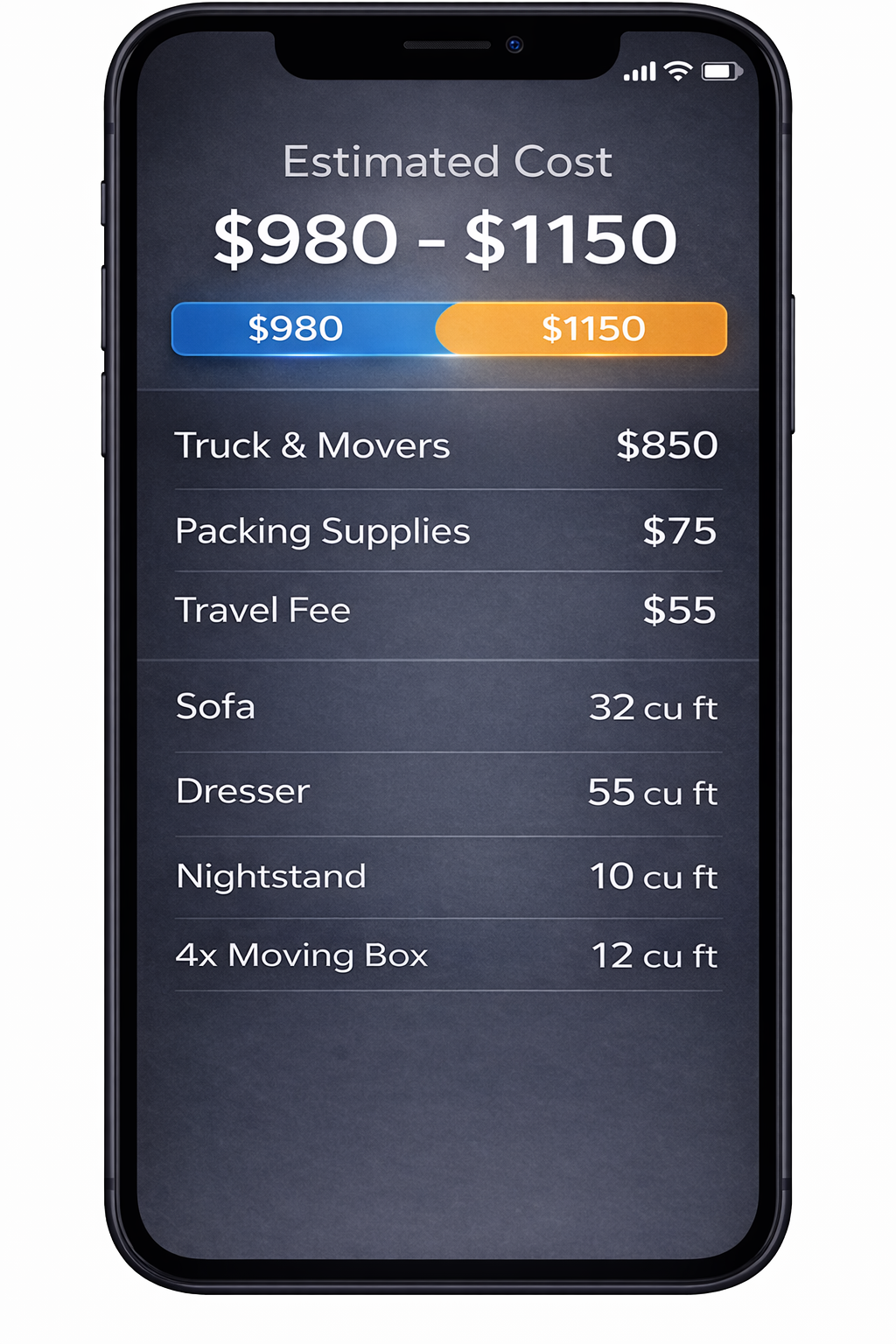
2. AI Detects Your Items
We identify your items and calculate volume for a clearer estimate.
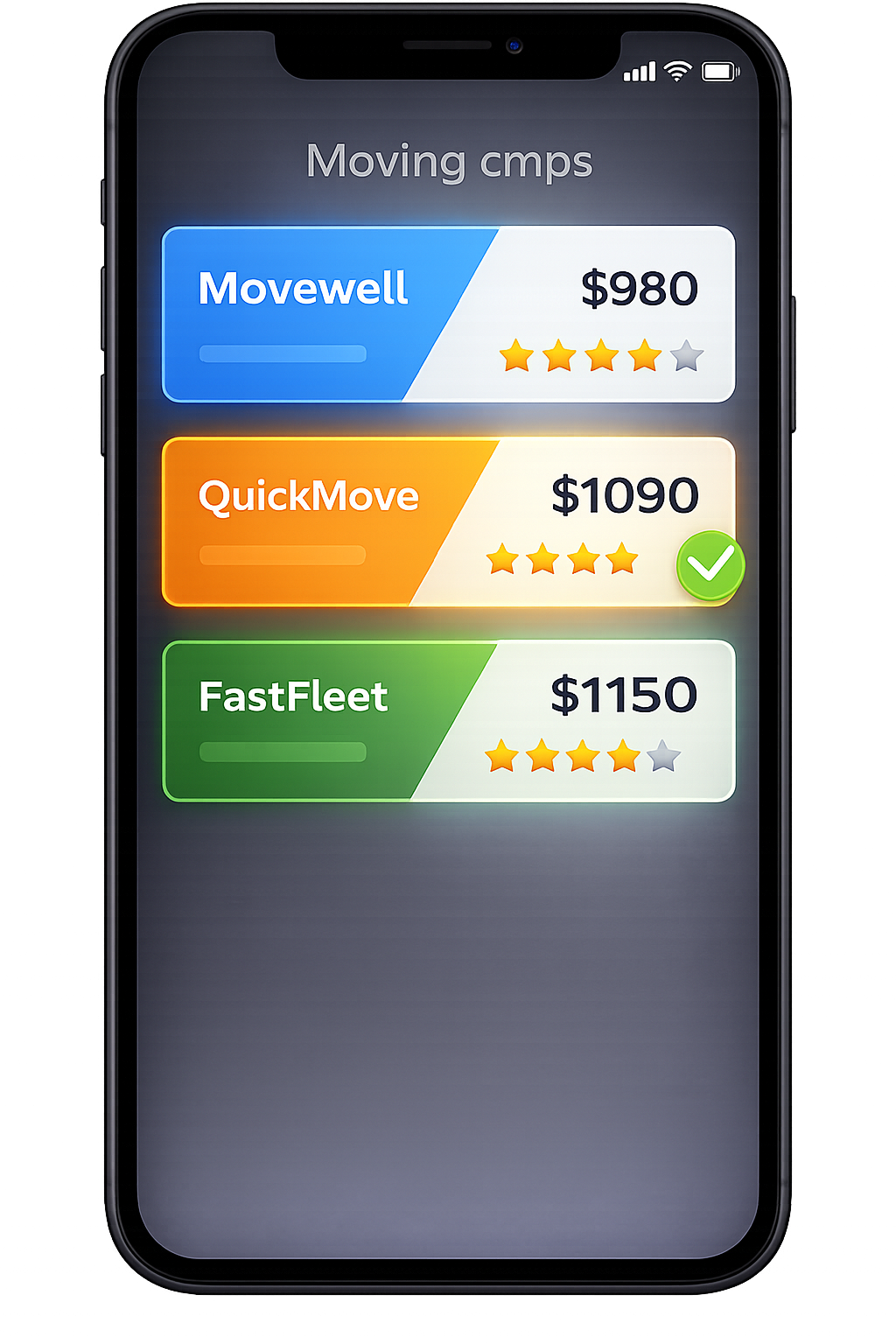
3. Compare Multiple Quotes
Compare mover quotes for Chicago, IL from the same scanned inventory.
Frequently Asked Questions
How much does it cost to move a 1-bedroom apartment in Chicago in 2026?
For a typical 1-bedroom move within the city, many people pay somewhere in the $450–$1,200 range with professional movers in 2026. You’ll sit toward the lower end if: You’re mostly packed and organized before the crew arrives Access is simple (few or no stairs, decent elevator, reasonable parking) Your route is short and not scheduled at the worst possible traffic time You’ll drift toward the higher end if: You have a lot of heavy furniture or more boxes than a standard 1BR Your building requires freight‑elevator reservations or has strict move windows The crew has to park far from the entrance or navigate multiple flights of stairs Using MoveCost’s AI scan and building questions lets movers see which of those buckets you’re closer to before they quote you.
Why do two local Chicago movers quote such different prices for the same move?
If you describe your move differently to each mover, they might not actually be pricing the same job. One may be picturing a light 1BR in a courtyard building; another may assume a fully loaded 1BR plus storage with tricky access. Even with the same info, movers can vary because they: Use different hourly rates and minimums Make different assumptions about how many hours your job will take Have different policies for travel time, stairs, elevators, and long carries MoveCost helps even that out by: Building one AI inventory that every mover sees Capturing the same stairs/elevator/parking details for all of them Letting you compare not just hourly rate, but estimated hours and what’s included That way you can see whether a lower quote is simply assuming less time or excluding services you actually need.
Is winter cheaper for moving in Chicago than summer?
Winter can sometimes be cheaper on paper—some movers offer lower rates or more flexible minimums when demand dips. But Chicago winters also slow down moves: Crews move more carefully on ice and snow They may have to lay extra floor protection in hallways and lobbies Parking and alley access can be trickier when snow piles up A move that takes four hours in mild September weather might stretch to five or six in January. You might pay a bit less per hour but need more hours. The best way to see the trade‑offs is to run your AI inventory through MoveCost and compare estimates for a few different dates in 2026, then ask movers how winter conditions might affect timing for your specific buildings.
How much of my Chicago moving cost is labor versus truck or travel fees?
On many Chicago local moves, labor time (loading, driving, unloading) is the largest component, with travel time and any flat truck fees layered on top. For example, a mover might quote: 3 movers × 5–7 hours of labor A travel charge that covers driving to your origin and from your destination back to their base Additional time or surcharges if there are multiple flights of stairs or a long walk from the truck MoveCost’s breakdown makes these pieces visible so you can see: How much time is being budgeted for actual loading/unloading How much covers drive time across the city Whether access (stairs, elevators, alley walks) is explicitly accounted for or just buried inside “extra time as needed.”
Do I still need an in‑home estimate if I use AI scanning?
For many apartments and smaller homes, an AI scan plus clear access notes give movers enough information to estimate accurately without an in‑person visit. You walk through your home once with your phone, and the system identifies the furniture and boxes that matter to movers. Some movers may still recommend a quick video call or additional photos if you: Have unusually heavy or fragile items (for example, a large piano, safe, or custom art) Live in a particularly tight walk‑up or older building with unusual access Are moving a very large home or combining multiple storage spaces In those cases, the AI scan becomes a strong starting point that keeps any further walkthroughs shorter and more focused.
How do I use this Chicago moving cost page with MoveCost’s other tools?
Use this page to anchor your expectations. Once you have a feel for what typical 2026 Chicago moves cost: 1. Run an AI home scan via the AI Moving Cost Calculator Online Free hub so you have a real inventory. 2. Use this cost page to see where your estimate sits relative to common Chicago ranges. 3. Go to Moving Quotes in Chicago, IL when you’re ready to request and compare offers from movers based on that inventory. 4. Visit Moving Company Cost in Chicago, IL if you want to dig into hourly minimums, travel fees, and company policies before choosing a mover. 5. For out‑of‑state routes, plug your inventory into Moving Cost Calculator by State and City or State to State Moving Cost Calculator Online to understand longer‑distance pricing before you talk to movers. All of those tools share the same AI inventory, so your Chicago cost planning stays consistent across every page you use.